Most bifold gate quotes go wrong for a dull reason. Somebody guessed. You don't need special gear to avoid that, just a tape, some string and maybe twenty minutes outside. Below is every number your bifold driveway gate size hangs on, roughly in the order you'd take them, plus a checklist at the end you can drop into an email as-is.
Grab a helper. Some of these are two-person jobs.
Start with the clear opening width
This is the gap between the inside faces of your two posts or pillars. No posts yet? Then measure at driveway level between where they'll stand. The System Equine driveway gate planning guide says the same, and it adds a warning worth taking seriously: settle the width before the posts or pillars go in, because moving a post later is expensive.
Take it three times. Top, middle, bottom. That's straight from the Gates & Fences UK bi-fold measuring guide, which also tells you to work from the smallest of the three. Why bother? Old brick pillars are rarely plumb, and a 30 mm lean you'd never spot by eye shows up the first time a panel swings shut.
Now picture what actually comes through. Everyday cars do fine at around 12 ft, by that planning guide's numbers, but towing a trailer or parking an RV pushes it to 16 to 20 ft. Say your pillars sit 14 ft apart and your boat trailer swings wide on the turn. Fine on paper. Annoying every Saturday.
One last thing here. On a trackless folding gate the motor is built into the cabinet post, so we need to know which number you're giving us: the gap between existing pillars, or the full wall-to-wall space. Those make two different drawings.
Measure the depth behind the gate line
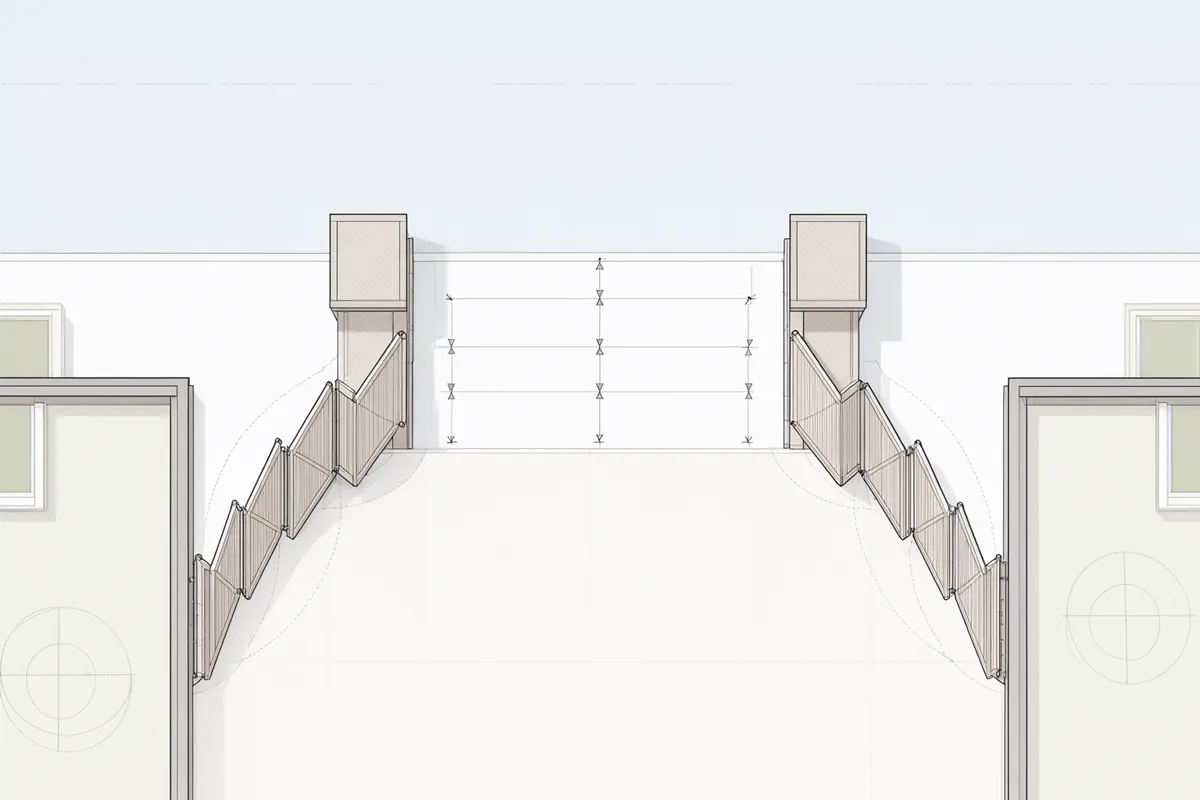
This is where a bifold earns its keep. A swing gate needs that big arc of empty ground for its leaves. A slider needs a long run off to one side, roughly 1.5 times the opening width according to the System Equine guide. The bifold shrinks the first and skips the second, and on a narrow lot that's usually what decides it.
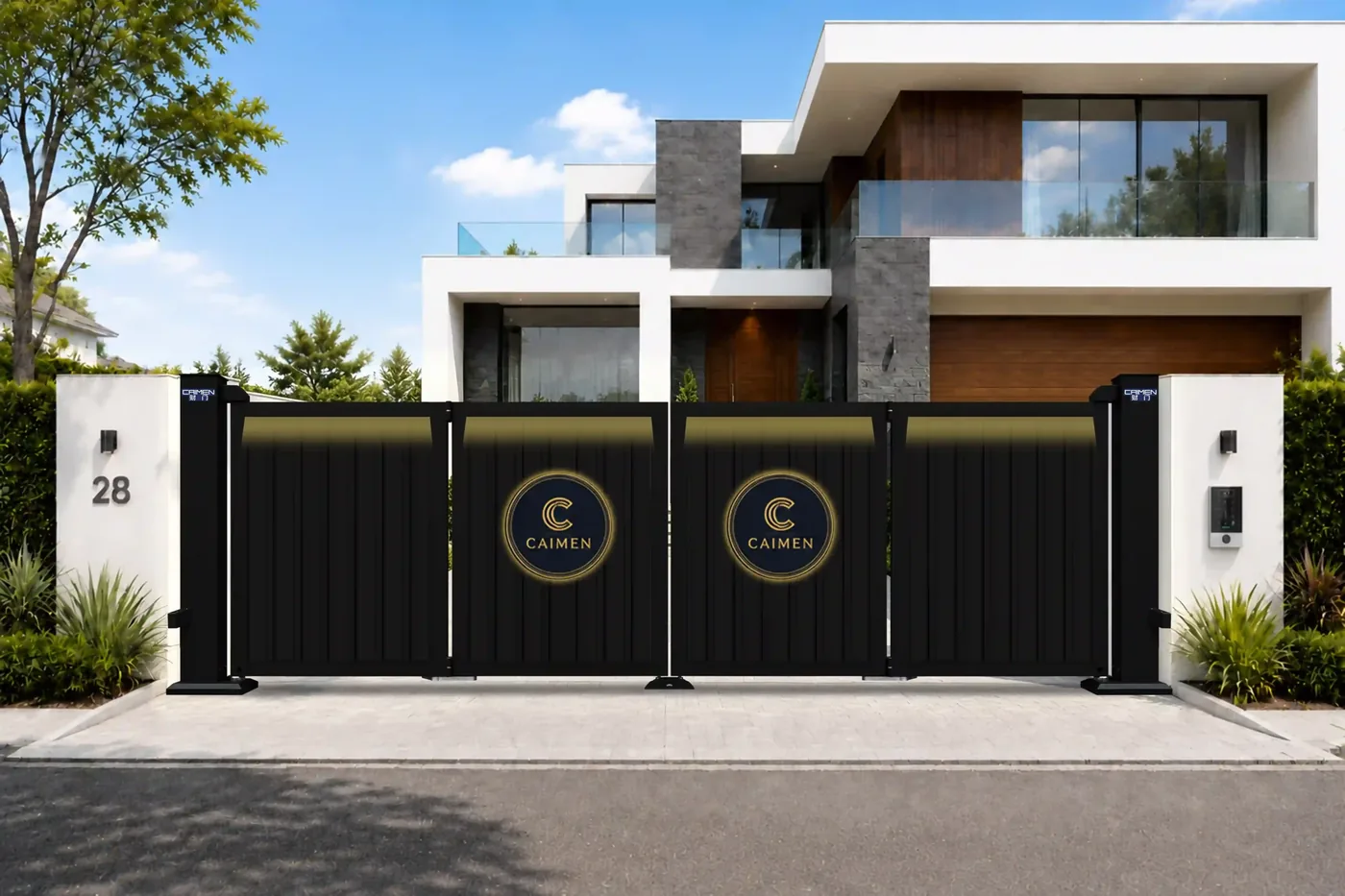
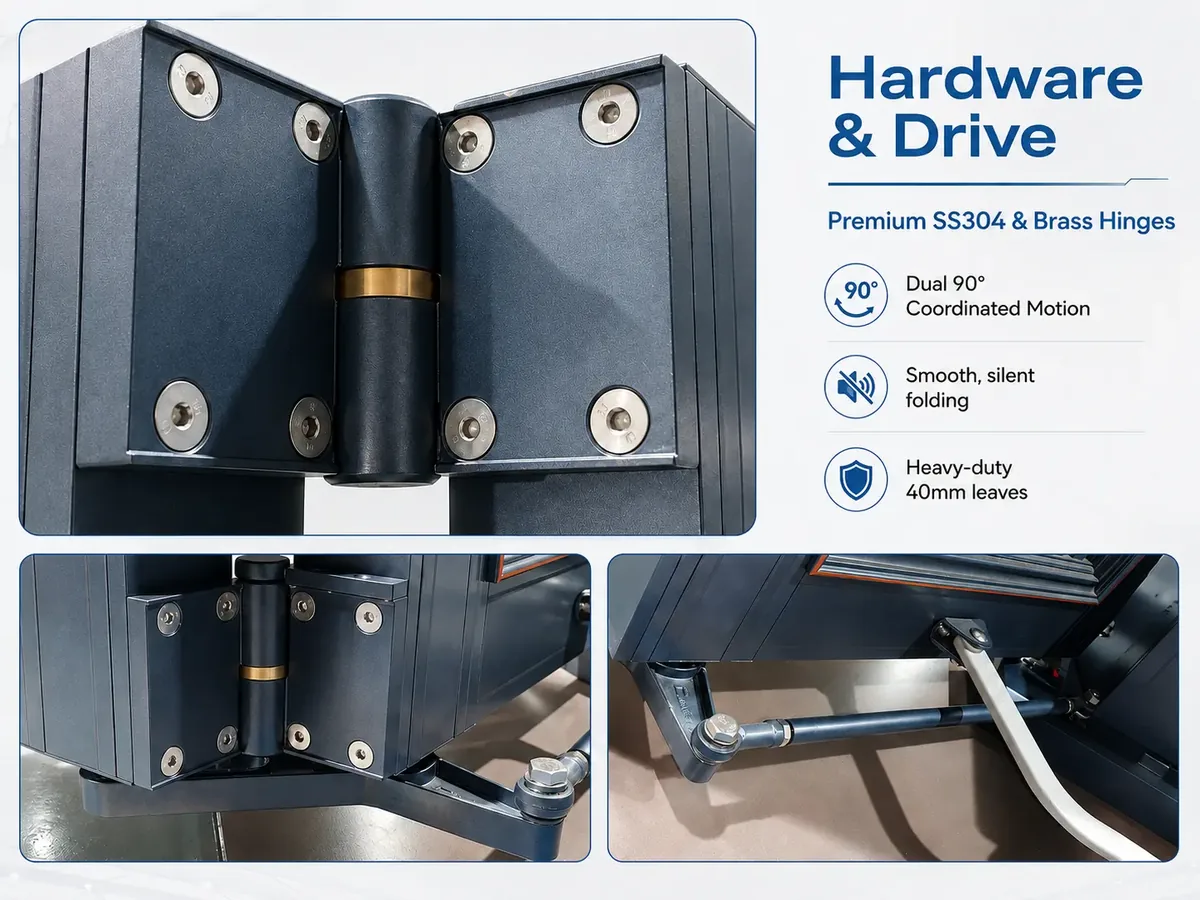
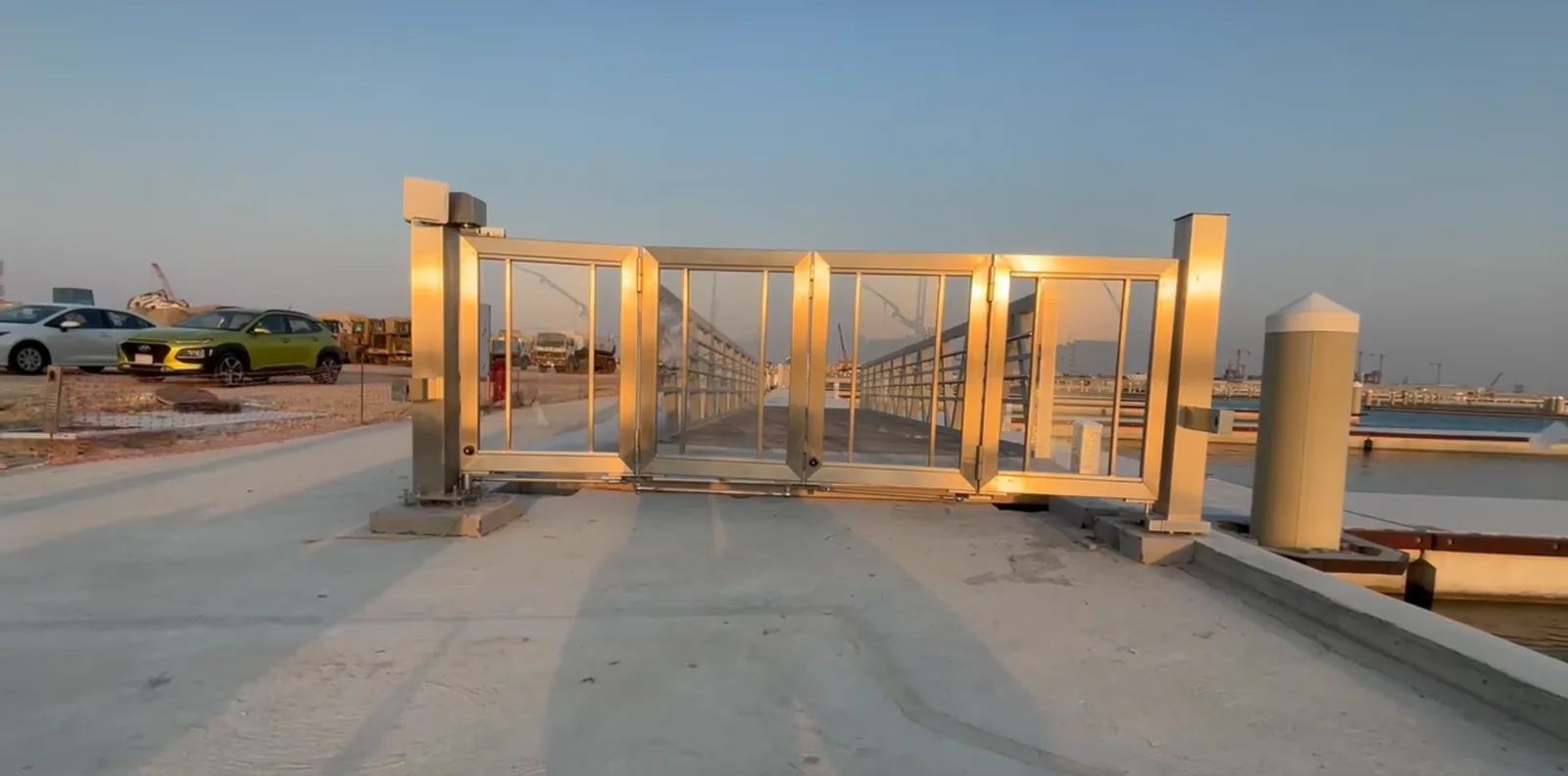
It isn't zero space, though. CAIMEN's folding gates run on a dual-track guide that turns the panels through 90 degrees in sync, and they stack back toward each side wall. You'll want two numbers per side:
- Straight wall length: how far the wall or fence runs inward from the post before it turns, steps or ends.
- Clear depth: gate line to the first thing a folded panel could hit. Think parked car, planter, meter box, step, downpipe.
Don't work out the folded stack yourself. Its depth depends on how many panels you pick and how wide each one is, and our CAD drawing handles exactly that. You just tell us what room exists. Honestly, a couple of photos shot from inside the property, looking out at the gate line, do more than most people expect.
Post sizes and what sits under them
Expect the cabinet post on a CAIMEN folding gate to be chunkier than a normal fence post. It has to hold the motor and wiring. These profiles come from our published material table, and they're 6005 and 6063 aluminum alloys.
| Part | Profile size (mm) | Approx. in inches |
|---|---|---|
| Cabinet (post) | 250 x 200 x 4.0 | 9.8 x 7.9 |
| Main frame | 128 x 90 x 3.2 | 5.0 x 3.5 |
| Inner frame | 110 x 50 x 1.5 | 4.3 x 2.0 |
| Stand tube | 47 x 37 x 1.3 | 1.9 x 1.5 |
So check that a 250 x 200 mm footprint fits next to each pillar, or in place of it. It shouldn't block a path, a mailbox or a gas line.
Then look down. CAIMEN's patented top-bottom axis system guides the gate from above and sends its weight through the bottom pivot into the ground, rather than hanging it off side connections on a wall. That puts the ground under each post first in line. Poured slab? Pavers on sand? Gravel, bare soil? We need to know, because the footing detail goes on the drawing. General practice, as the System Equine guide notes, is to size footings for gate weight and soil and take them below the frost line.
Heights: match the leaf to a model
Height's the easy one. People still forget it. Measure your current pillars, wall caps and fence tops so the new posts line up instead of sticking out like a sore thumb, and check whether your HOA or town caps gate height.
Our standard CMZD models all use a 2.0 m leaf. Post height comes in two versions:
| Model | Leaf height | Post height |
|---|---|---|
| CMZD-1811, CMZD-1812 | 2.0 m (about 6 ft 7 in) | 2.08 m (about 6 ft 10 in) |
| CMZD-1806, CMZD-1902, CMZD-2001, CMZD-2102 | 2.0 m (about 6 ft 7 in) | 2.3 m (about 7 ft 7 in) |
Haven't picked a look yet? Have a browse through the gate designs and jot down the model you like. Putting that one code in your email cuts out a whole round of questions.
Slope and the ground surface
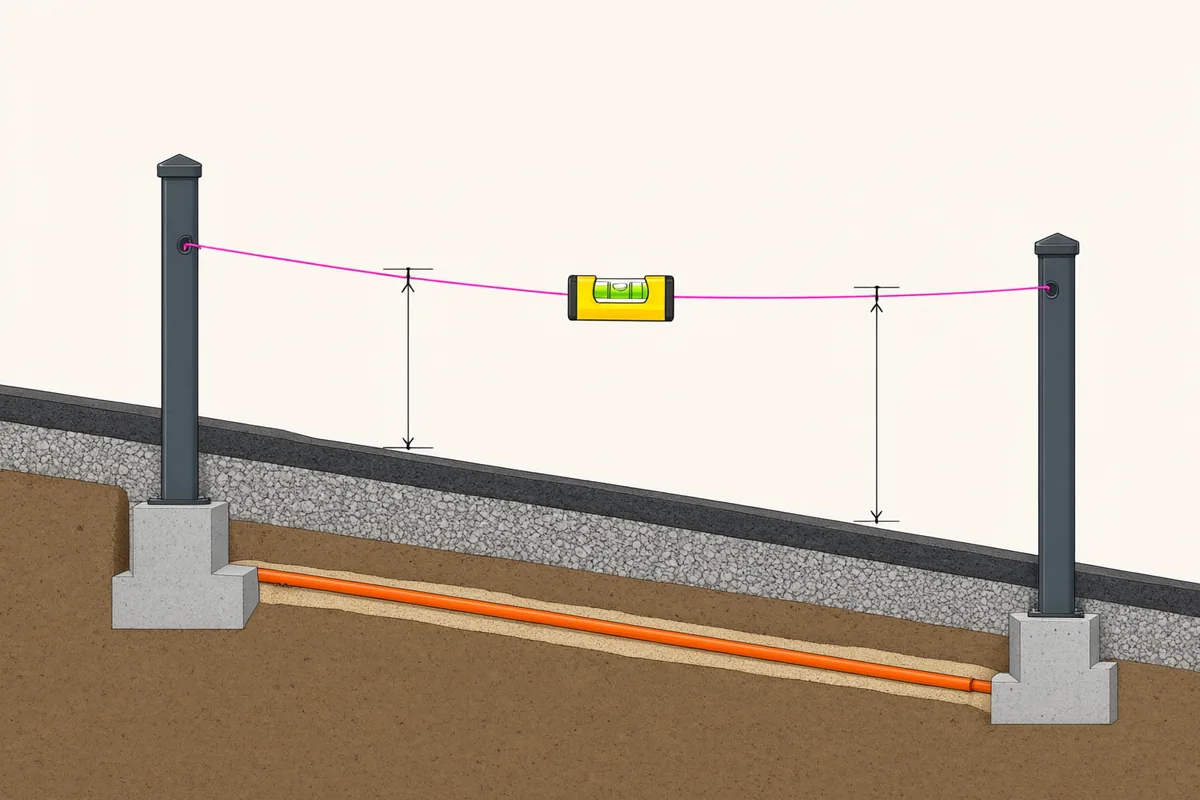
Perfectly flat driveways are rare. Most drop toward the street so water drains, and plenty lean sideways as well.
The System Equine guide points out that swing gates want fairly level ground over their whole arc, while sliders only care about the opening. A bifold lands somewhere in the middle. Its panels travel inward over the strip just behind the gate line, so check that strip too, not just the opening.
It's a five-minute job:
- Tie a string between the two post positions at the same height and level it with a line level.
- Measure down from the string to the ground at each post and at the middle. The difference is your cross-fall.
- Repeat from the gate line straight inward, about 2 m (6 ft) along each side, to get the fall into the property.
Note the figures in inches or millimeters. Then sketch it, with arrows for which way water runs. That sketch beats a long paragraph every time. Good news on this front: CAIMEN's folding gates are fully suspended with no pre-embedded track, so there's no channel for rain, snow or standing water to collect in. You'll still need the slope on the drawing.
Plan the 24V power supply
CAIMEN's folding gate uses a 24 V DC brushless motor rated at 200 W. It draws 6 A and runs off a 24 V / 10 A power supply, and a full open or close takes 6 to 12 seconds. Low voltage at the gate is pleasant to work with. The supply itself still hooks into mains power, though, and that's a licensed electrician's job under your local code.
From you, we only need two answers. How far is the nearest power source from the cabinet post? Is there already a conduit under the driveway? If you're adding a keypad, RFID reader, license plate recognition, video intercom or ground loop, mark where each will go. Every one means another cable run, and nobody wants to dig the same trench twice.
The checklist to send for a quote
Copy this, fill it in, attach your photos. Done.
| Item | How to measure | What to send |
|---|---|---|
| Clear opening width | Inside face to inside face, top, middle and bottom | All three numbers, smallest marked |
| Wall-to-wall width | Full gap if posts will be new | One number |
| Straight wall each side | From post inward to first corner or end | Left and right |
| Clear depth behind gate line | Gate line to nearest obstruction | Left and right, plus what the obstruction is |
| Post space | Room for a 250 x 200 mm cabinet | Yes or no, with photo |
| Ground under posts | Look and dig a little | Slab, pavers, gravel or soil |
| Target height | Existing pillars, walls or fence | Height and preferred CMZD model |
| Cross-fall | String line between posts | Drop in inches or mm |
| Fall into property | String line inward about 2 m | Drop and water direction |
| Power | Distance to nearest supply | Distance, conduit yes or no |
| Access controls | Where keypads or readers go | List and rough locations |
With that in hand, our CAD team draws up plans and renderings for your site. Nothing gets made until you sign off, and production typically takes 15 to 20 days after drawing approval. Treat that approval as your safety net. Check every dimension.
Want to see how finished gates suit different sites? There's our bifold driveway gates page, and if your plot is tight, folding gates for small driveways is worth a read. Got your numbers? Send them through the contact page or email yifei@gmail.com.
Sources
- The Complete Driveway Gate Planning Guide (System Equine)
- How to Measure for Metal Framed Bi-Fold Gates (Gates & Fences UK)
CAIMEN product figures come from our installation manuals and engineering documentation.