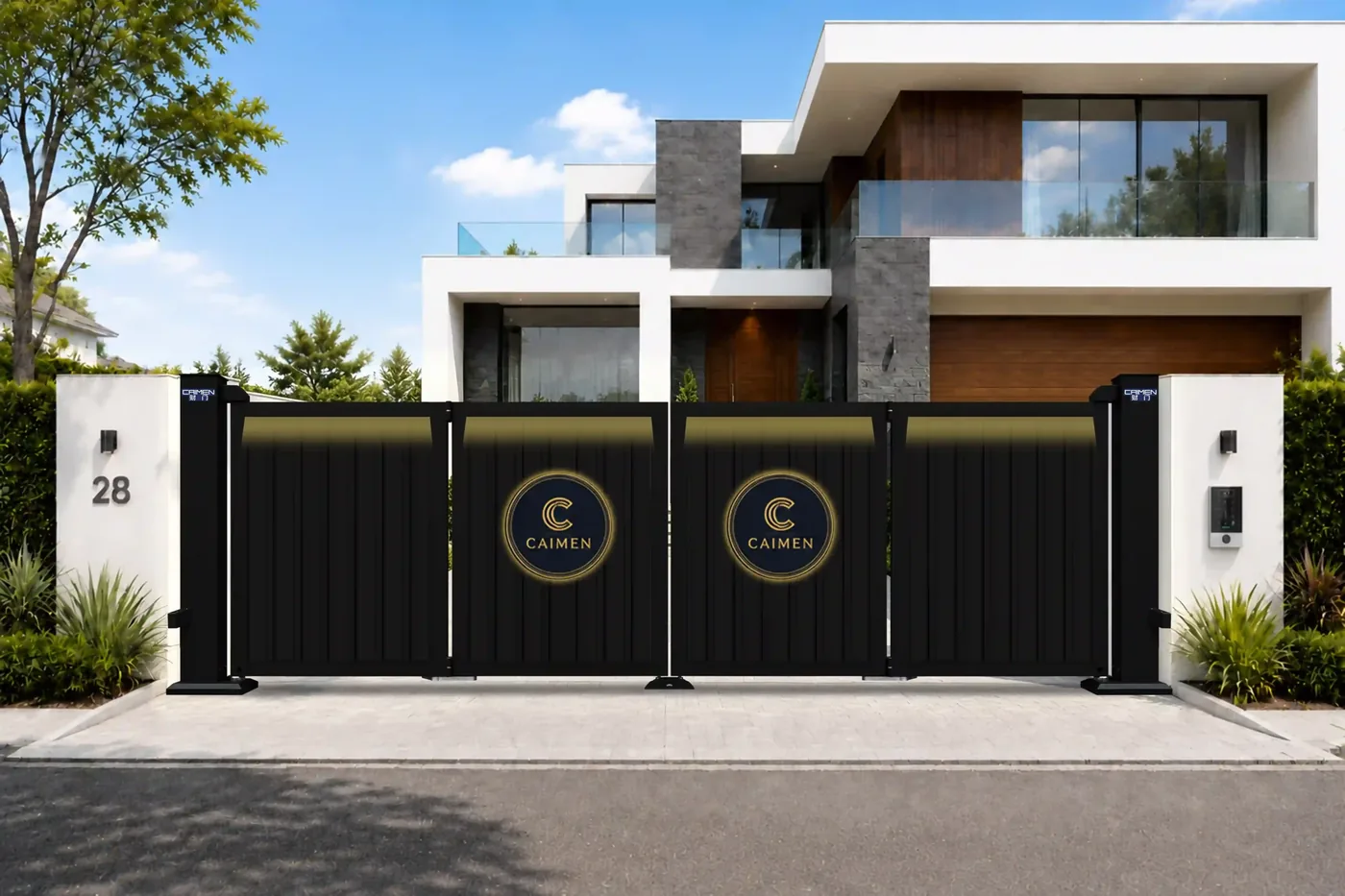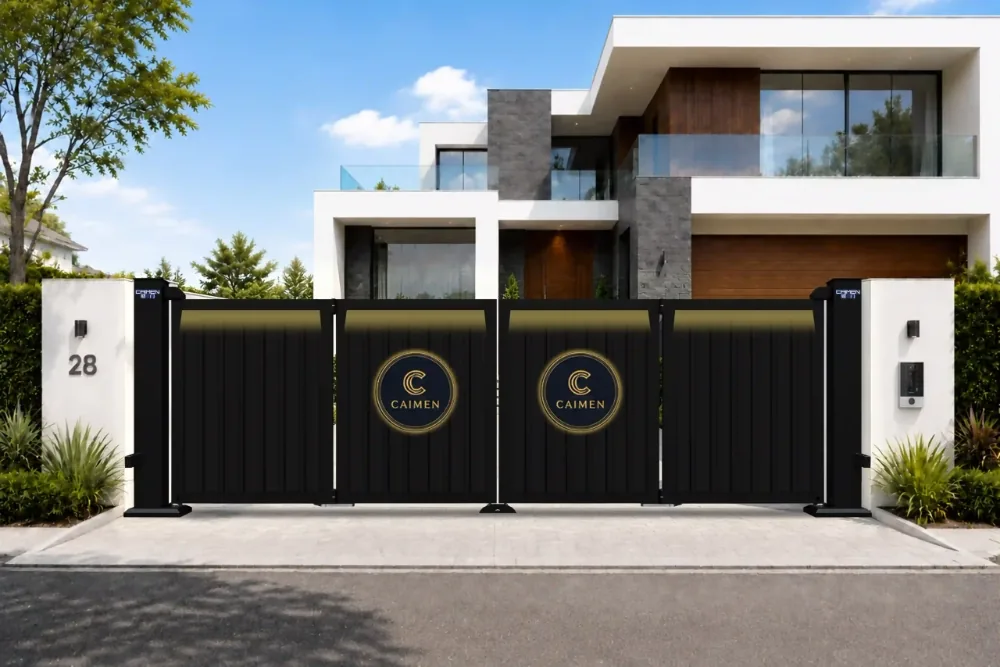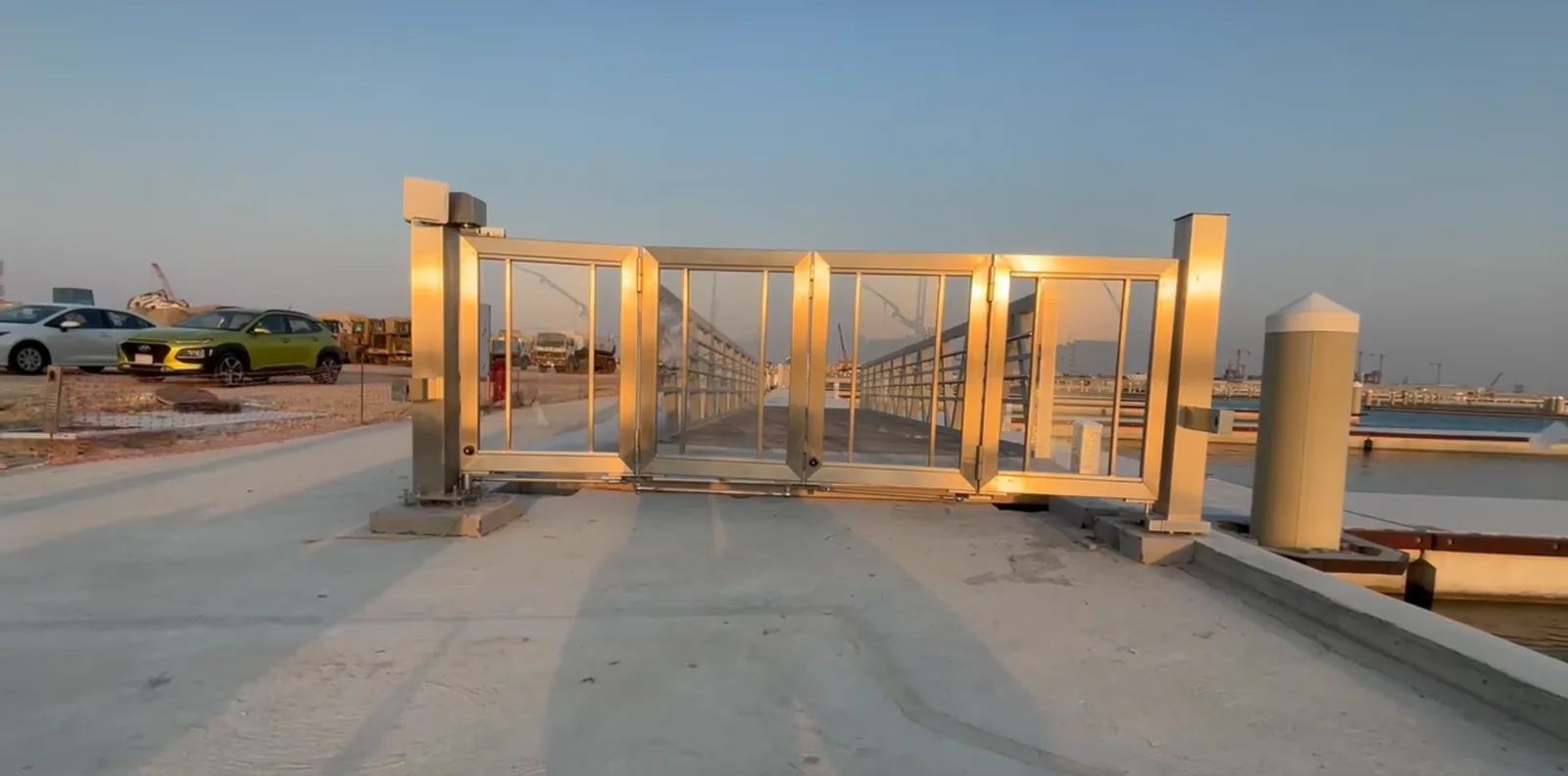
Every bifold gate carries its weight somewhere. On most designs, that somewhere is a stack of side hinges bolted to a post, and that's exactly why so many folding gates start to droop after a few seasons. This article walks through the load path, what fails first, and how a top-bottom axis moves the weight off the hinges and down into the ground.
Short version? Hinges are good at letting things turn. They're bad at holding things up.
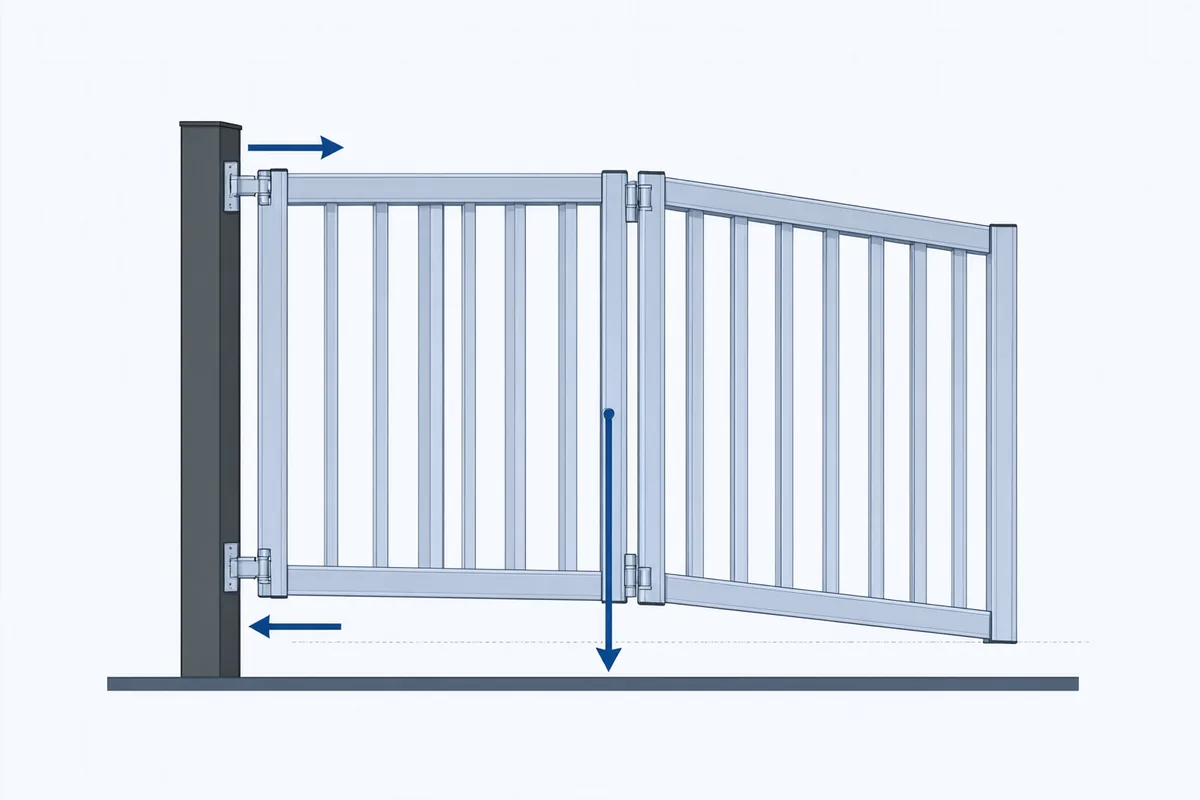
Where the weight goes on a side-hinged gate
Picture a single aluminum leaf hung off a post on two hinges. The leaf's center of gravity sits out in the middle of the panel, not at the hinge line. Gravity pulls that center down, and because it's offset from the post, it creates a turning force. The top hinge gets pulled away from the post. The bottom hinge gets pushed into it. That pair of forces is what keeps the leaf from rotating down and outward.
Now fold the problem. A bifold leaf is two panels joined by an intermediate hinge, so the outer panel hangs off the inner one. Its weight has to travel through the folding hinge, through the inner panel's frame, and only then into the post hinges. The lever arm gets longer. So does the list of joints that can wear.
Each of those joints is a small sliding contact: a pin turning inside a knuckle or bushing. Under a steady sideways load, the pin rubs on one side of its bore every single cycle. That's where the slop starts. A tenth of a millimeter of wear at the top hinge doesn't sound like much, but out at the latch end of a long leaf it shows up as a visible drop.
Wear isn't the only culprit
Hinges usually get blamed, and sometimes they deserve it. Still, the guides from This Old House point to a loose or leaning post as a very common root cause, along with frames that rack out of square. Angi's sagging-gate guide lists the same suspects: bent or rusted hinges, screws that strip out of the post, and a post tilting in the soil under the gate's weight. On a residential picket gate, those fixes are a Saturday job. On a motorized bifold driveway gate, a drooping leaf also means a motor working harder and safety sensors that may no longer line up.
There's also a materials issue. Stainless steel is a sensible choice for a hinge pin outdoors, but as Fractory's explainer on galling notes, stainless and aluminum surfaces in sliding contact under high pressure can stick, tear and transfer material. More load on a small contact patch makes that worse. Less load makes it better.
How a top-bottom axis changes the load path
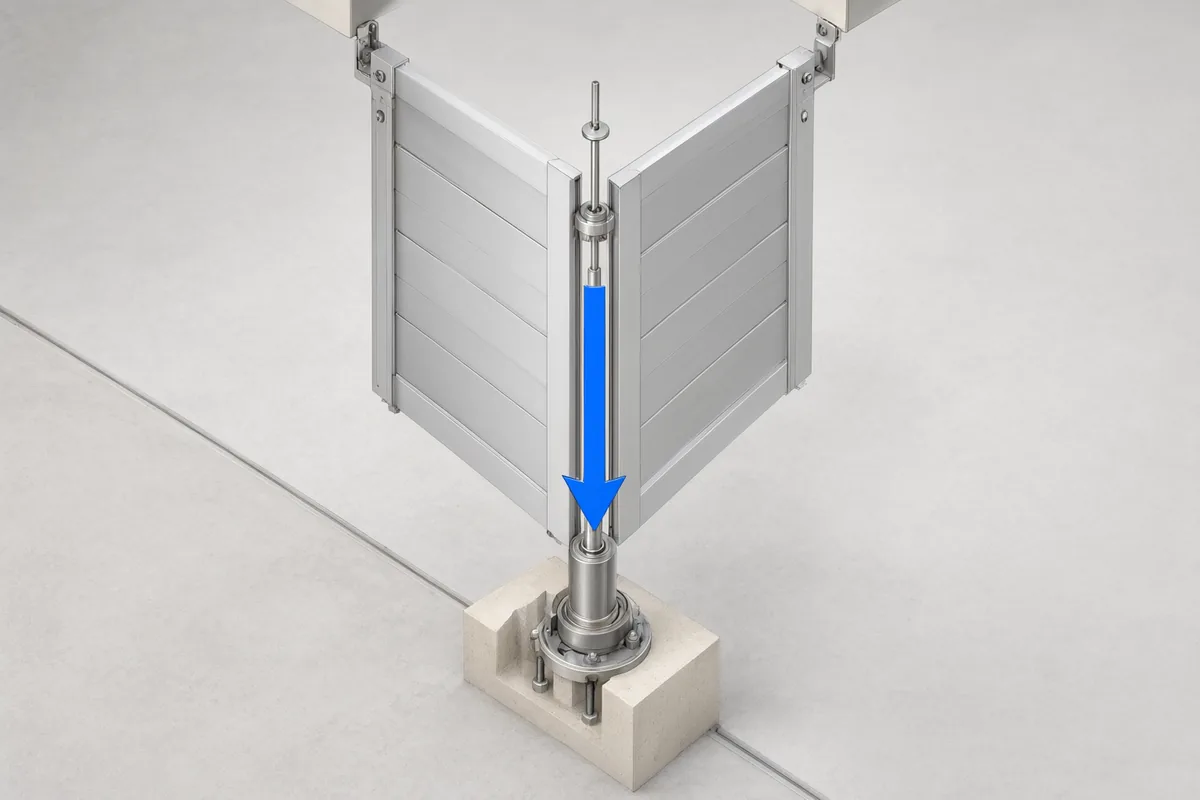
CAIMEN's folding gates use a patented top-bottom axis support system. The idea is simple: split the jobs. The bottom pivot is the load-bearing point, and the gate's weight goes straight down through it into the ground foundation. The top pivot handles guidance, keeping the leaf plumb and on its arc. Side connection points no longer have to carry the full weight of the leaf.
Think about what that does to the hinges. When the weight drops vertically through a pivot at the base, the big turning force that tries to peel the top hinge off the post mostly disappears. The hinges go back to doing what they're good at, which is rotating.
A few details from our engineering documentation are worth knowing:
- The top pivot is precision-machined on CNC equipment.
- The bottom pivot is a patented structure with four layers of protection.
- According to CAIMEN's engineering data, a single bearing assembly supports 5 to 10 tons.
- Compared with traditional support shafts, CAIMEN reports mechanical wear reduced by roughly 60% and service life extended up to 3 times.
Those last two figures are CAIMEN's own data, not an independent lab result, and you should read them that way. What doesn't need a lab to verify is the geometry. A vertical load on a base pivot is a far kinder load case than a cantilever hanging off a post.
You can read more about the axis and the rest of the drive train on our technology page.
The hinge shaft and the synchronized fold
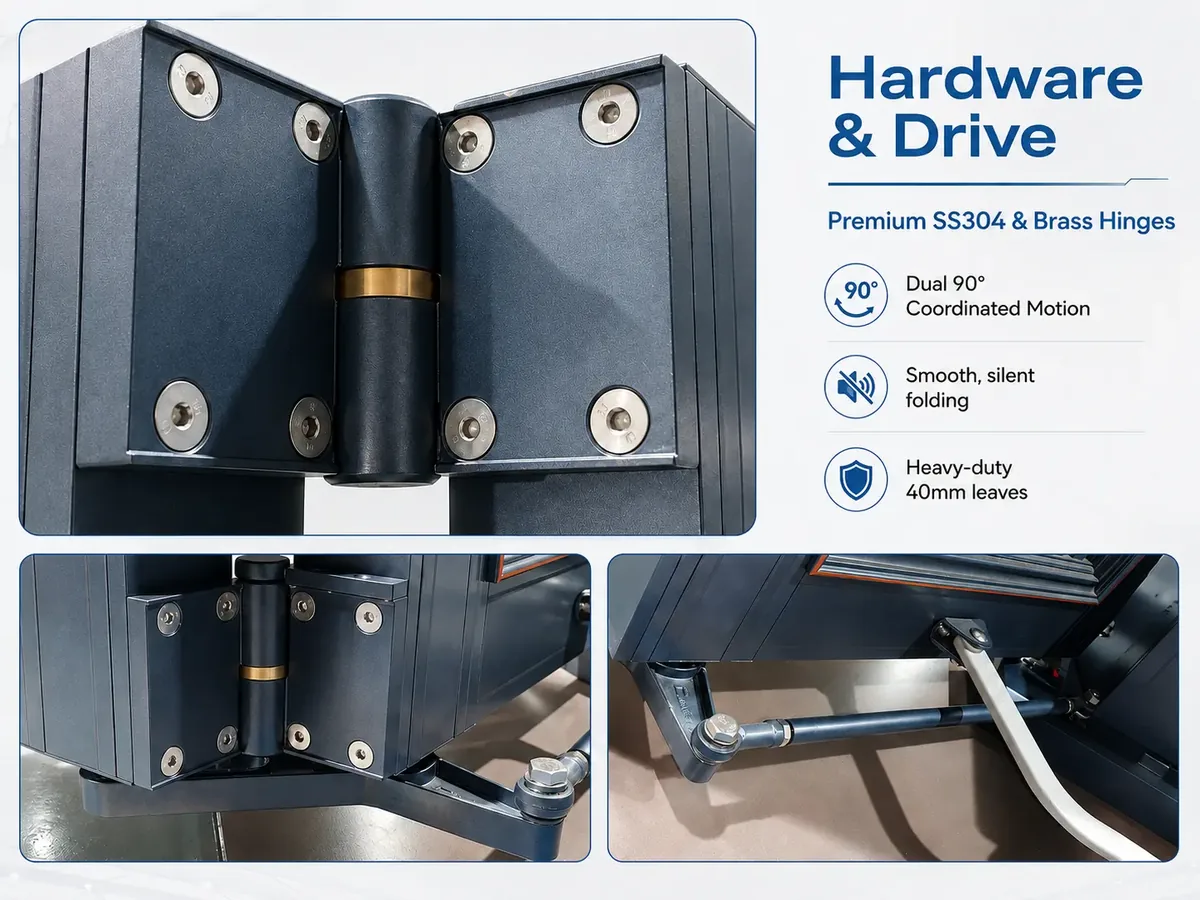
Moving the weight to the bottom pivot doesn't mean the folding hinge can be flimsy. It still has to keep two panels aligned through every open and close, in wind, for years. CAIMEN's hinge shaft is 304 stainless steel, precision-cast at 1500 °C, with a reinforced 40 mm diameter, running with precision bearings so it stays quiet.
The second piece is the patented folding guide. It's a dual-track synchronized 90° system, meaning both rows of panels open and close through 90° together. That matters for sag in a way people don't expect. When one side of a fold lags the other, the joint twists, and a twisted joint wears on the edge of its bore instead of evenly. Keeping the panels in sync cuts down friction and vibration and stops the uneven stick-and-jerk that loosens hardware over time.
| Item | Typical side-hinged bifold | CAIMEN top-bottom axis bifold |
|---|---|---|
| Where leaf weight goes | Through hinges into the side post | Down through the bottom pivot into the foundation |
| Job of the top connection | Resists pull-out from the post | Guidance, keeps the leaf plumb |
| Hinge shaft | Varies by maker | 304 stainless, cast at 1500 °C, 40 mm |
| Panel coordination | Often linkage only | Dual-track synchronized 90° guide |
| Floor track | Sometimes needed | No pre-embedded track required |
| Wear vs. traditional support shaft | Baseline | About 60% lower, life up to 3x (CAIMEN data) |
Because the weight sits on a pivot rather than a rolling wheel, there's no need for a pre-embedded floor track, and rain, snow or standing water at the threshold don't foul anything. That's the main reason the design works so well as a trackless folding gate.
Early signs your folding gate is sagging
Sag rarely arrives overnight. It creeps. Here's what to look for, roughly in the order it tends to show up:
- The latch or lock stops lining up. You have to lift or shove the leaf to close it. This is usually the first clue.
- Uneven gaps. The gap between the two meeting leaves is wider at the top than the bottom, or the gap at the fold changes from top to bottom.
- Scuffs on the ground. A shiny arc on the paving under the leaf tip means it's dragging.
- Noise. Squeaks, clicks or a grinding feel at the hinge where it used to be quiet.
- A motor that works harder. Cycles take longer, or the gate stalls partway. On CAIMEN's 24 V controller, an E-1 code points to over-current, which a binding leaf can cause.
- Safety beams that drift. If the infrared photocells start throwing false stops, check the leaf height before blaming the sensors.
For a quick check, borrow the carpenter's trick This Old House describes: measure the frame corner to corner in both directions. If the two diagonals don't match, the panel has racked. Then put a level on the post. Leaning post, square panel? Your problem is the foundation, not the hinge.
What to check on a top-bottom axis gate
The axis design moves the failure point. Instead of watching the side hinges, you watch the base. Say you're responsible for a gate on a busy commercial entrance, opening and closing all day for delivery vans. A sensible routine looks like this:
- Look at the slab around the bottom pivot. Cracks or settlement there matter more than anything else, because that's where the weight lands.
- Check the top pivot for play. It isn't carrying the load, so any looseness there is a sign something below has moved.
- Watch the panels fold. Both rows should hit 90° together. If one lags, get it adjusted before the fold joint starts wearing on one edge.
- Inspect the cable run. CAIMEN routes power through a 304 stainless flexible conduit with oxygen-free copper cable, so look for kinks or chafing at the fold.
- Keep sliding contacts clean. Grit is what turns normal wear into scoring.
Honestly, the foundation pour is the step to get right. A well-built pivot on a poor slab will still drop. Our installation page covers the site prep side.
Is a top-bottom axis worth it?
For a light pedestrian gate that opens a few times a day, a good set of side hinges and a solid post can do the job. Once leaves get wide, heavy, or motorized, the math changes. Every extra kilogram hanging off a post hinge adds turning force, and a motor cycling the gate dozens of times a day turns small wear into visible sag much faster.
That's the case for putting the weight on the ground. It isn't magic, and it doesn't excuse a weak slab. It just stops asking hinges to do a job they were never designed for.
If you're comparing designs for a specific opening, send the width, height and site photos to yifei@gmail.com or use our contact page. CAIMEN prepares CAD drawings before production, and production typically runs 15 to 20 days after drawing approval.
Sources
- Why Fence Gates Sag and How to Fix Them - This Old House
- How to Fix a Sagging Gate: A DIY Guide - Angi
- Galling: What Is It, How It Works and Prevention - Fractory
CAIMEN product figures come from our installation manuals and engineering documentation.