The sea doesn't care what your gate cost. Spray blows in off the water and settles on a hinge, a fastener, a cable gland. It dries to a white crust. Overnight that crust pulls damp back out of the air, and by breakfast it's wet again. Coastal gate corrosion almost never starts somewhere obvious. Check a screw head. A weld toe. The hairline gap where the motor cover meets the post.
Showroom looks won't tell you much here. Villa gate or marina entrance, the real test comes years later: does it still look right, and does it still fold shut without a groan?
Two builds hold up near the water. Solid marine grade stainless is one. Aluminum under a properly tested coating is the other. We'll go through both, then take apart a real CAIMEN folding gate on the Red Sea coast, spec by spec.
Why salt air is harder on gates than rain
Rain rinses a gate. Spray leaves something behind.
What it leaves is chloride. Stainless steel stays stainless thanks to a thin chromium oxide film, and chloride ions attack that film at its weak spots. One breach becomes a pit: a small, deep hole that grows quicker than ordinary rust and stays hidden right up until a brown streak shows on the post.
Aluminum gets hit too. Sure, it forms its own oxide skin. Chlorides etch and pit it anyway. And if the paint cracks, at a cut edge or a stone chip by the latch, damp works in behind the film and lifts it.
My order of worry on a seaside job? Coating first. Color a distant second.
Now add moving parts. Hinges, pivots, a motor, plus wiring that bends every time the leaves fold. Each joint is a crevice, and salty water loves a crevice. A fence panel only has to survive out there. Your gate has to survive and still open on command.
304 vs 316: the molybdenum difference
Fresh out of the crate, nobody can tell them apart. Both are austenitic stainless. The split is in the chemistry. Pfannenberg's technical note on the two grades puts 304 at roughly 18% chromium and 8% nickel, with 316 adding about 2% molybdenum. That molybdenum is what lifts resistance to chloride pitting, and the same note recommends 316 for coastal and marine settings with higher chloride levels.
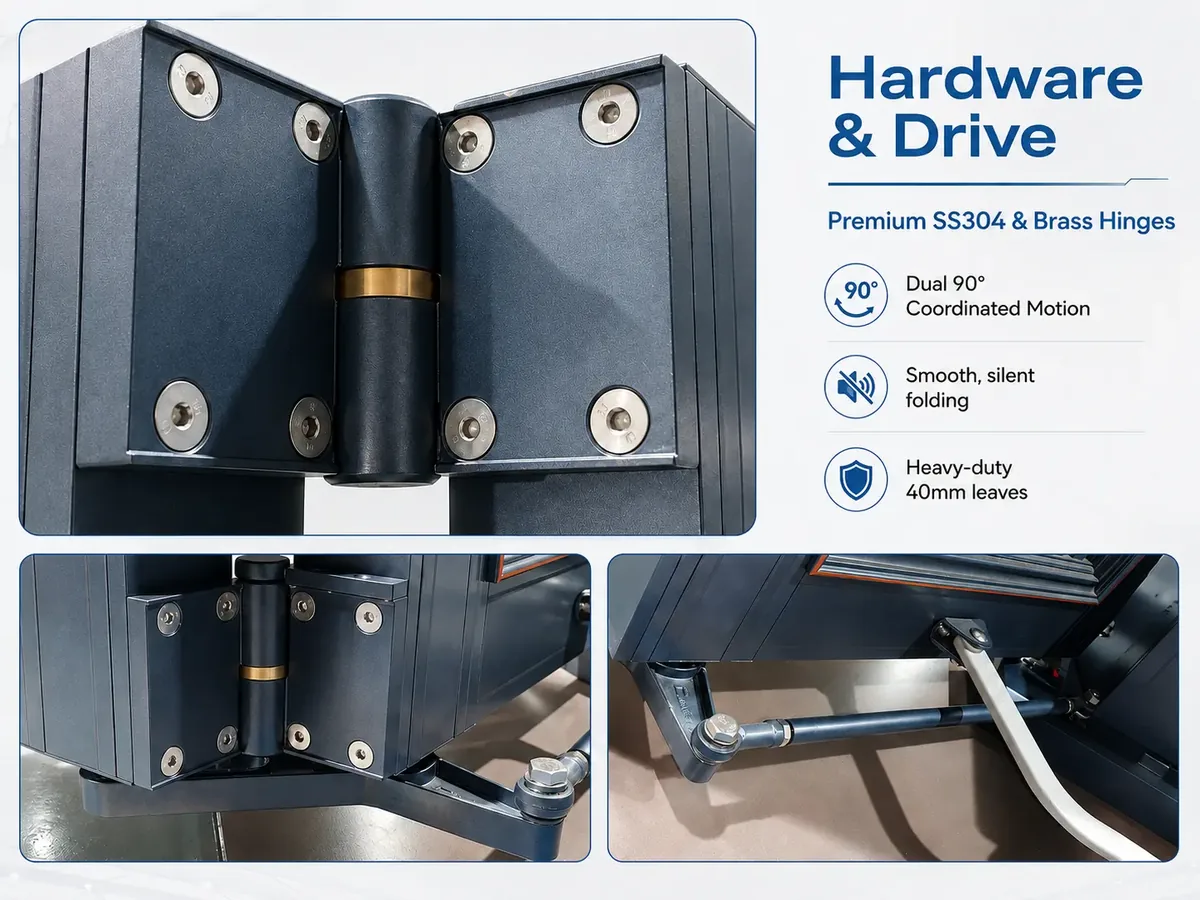
Inland, 304 is fine. Really. CAIMEN puts it on standard folding gates: the 40 mm 304 stainless hinge shaft, the 304 stainless flexible conduit around the motor cable. Away from the coast, that's sound engineering.
Can you see salt water from your drive, though? Upgrade the structure and every exposed bit of hardware.
And "marine grade" isn't a finish. Not a coating, not a polish. It means 316 (or better) on every part the spray can touch.
Case study: a Red Sea marina folding gate in SS316
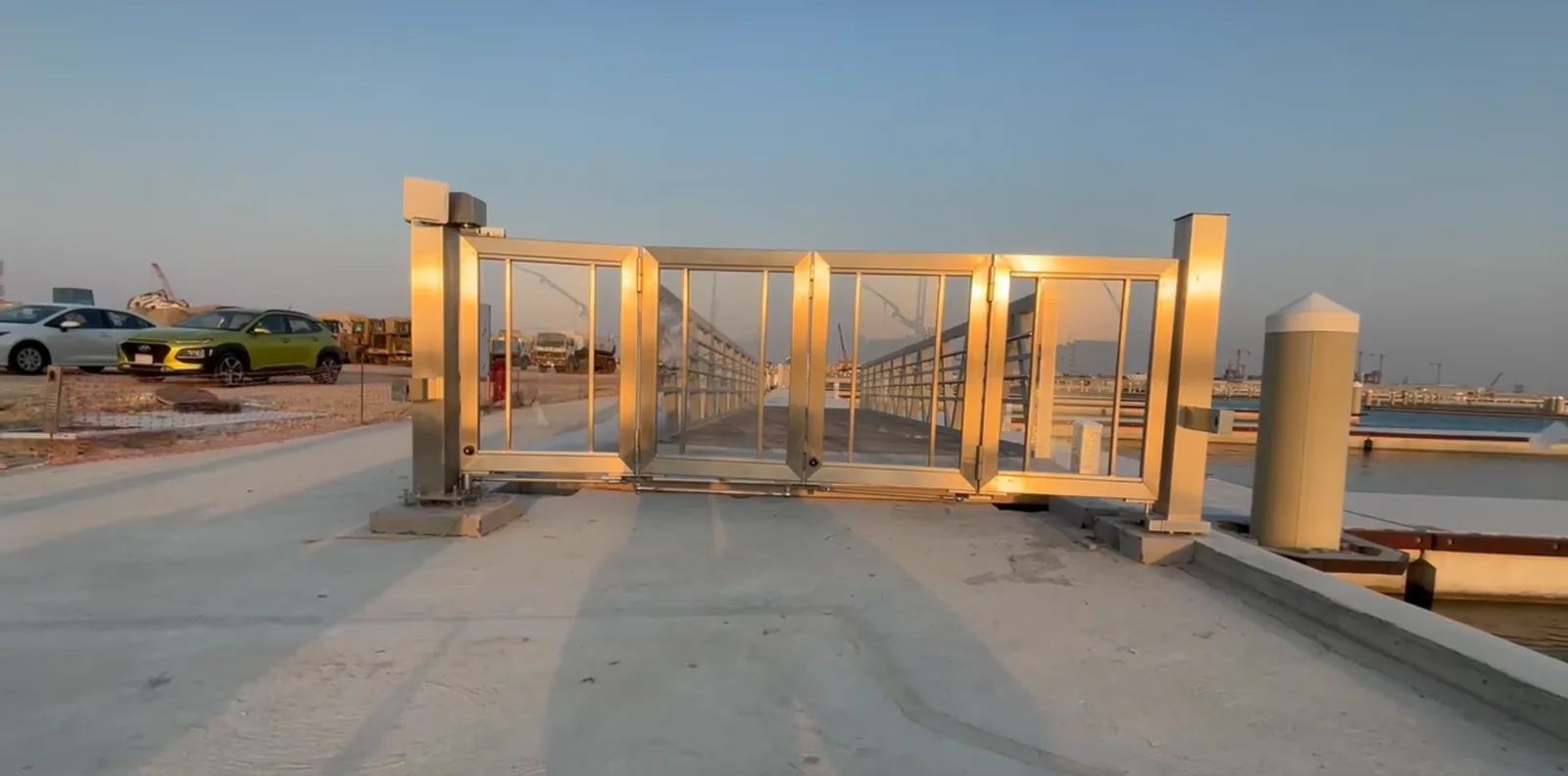
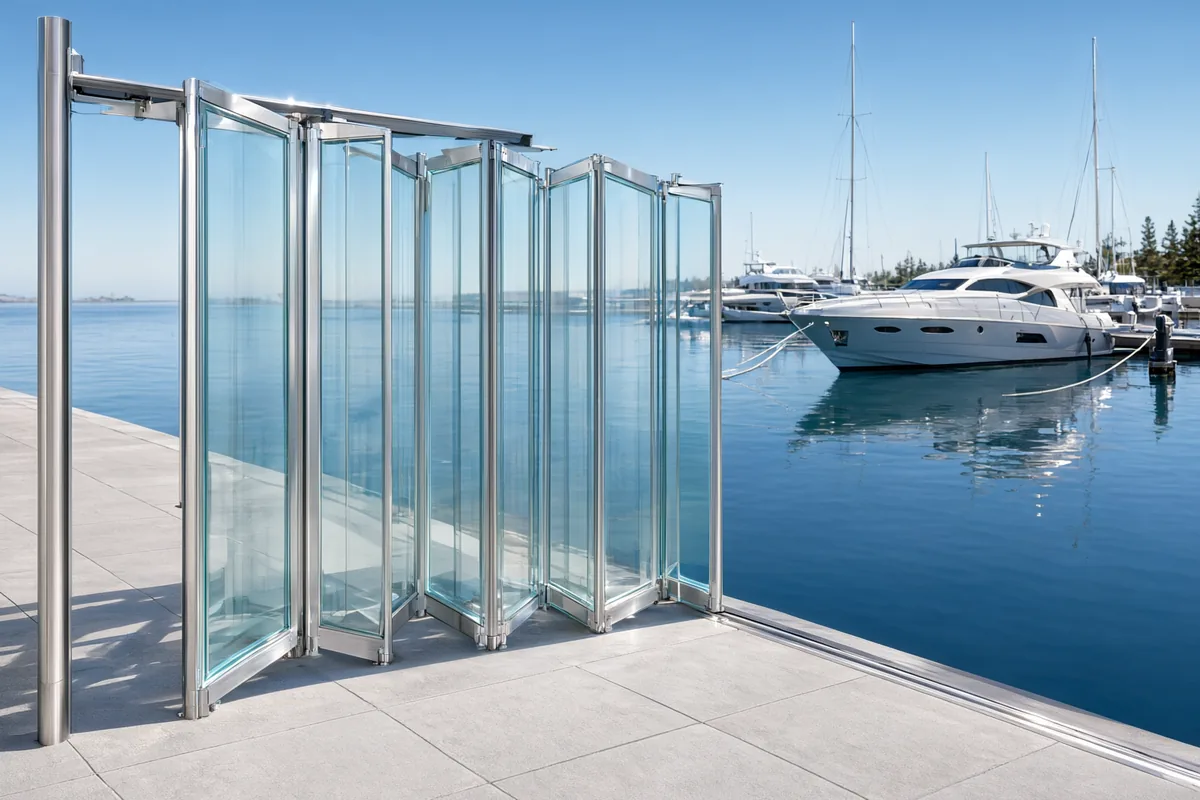
The brief came from a high-end marina construction contractor in Saudi Arabia: a fully customized folding entrance right on the Red Sea coast. Heat. Humidity. Salt and hard sun, all at once. Our Red Sea marina project page has the short version. Read the spec slowly, though, because it shows how far past the frame corrosion protection has to reach.
Structure and hardware
All of it was SS316 stainless with 2 to 3% molybdenum. Structure and hardware both, fasteners and fittings included, not just the panels people photograph. Why go that far? Drop a single 304 screw into a 316 frame and it'll be the first thing to stain.
Glass
Infill is laminated tempered glass: 6 mm + 0.76 mm PVB + 6 mm, roughly 12.76 mm overall. The spec references EN 14449, ANSI Z97.1 and GB 15763.3 with EN 12600 impact classification, works from -40 to +120 °C and lets through at least 85% of the light. Glass doesn't rust. On a quay that's half the point, since each pane is one less metal face turned to the wind.
Motor and access control
The drive is a concealed in-column DC 24 V motor rated 150 to 200 W. It draws under 3 A. Maximum torque is 500 N, and it opens in 15 to 25 seconds per 90°. Rated IP52, for -25 to +45 °C.
IP52 won't survive a soaking. That's why the motor sits inside the stainless column, a choice made at the design stage rather than patched in later. Access runs on long-range RFID at 860 to 960 MHz, reading at 8 to 10 m in under 10 ms, so authorized vehicles are identified while they're still approaching.
What happened next
CAIMEN ran structural verification and load analysis before anything shipped. Parts went out in full wooden crates. Our engineers traveled to the site to guide installation and commissioning.
Then the long haul. After long-term operation on the Red Sea coast, every SS316 component and the electrical systems stayed free from corrosion or oxidation, with the gate running 24/7, unattended.
That's the line worth remembering.
The aluminum alternative: AkzoNobel D2000 and AAMA 2604
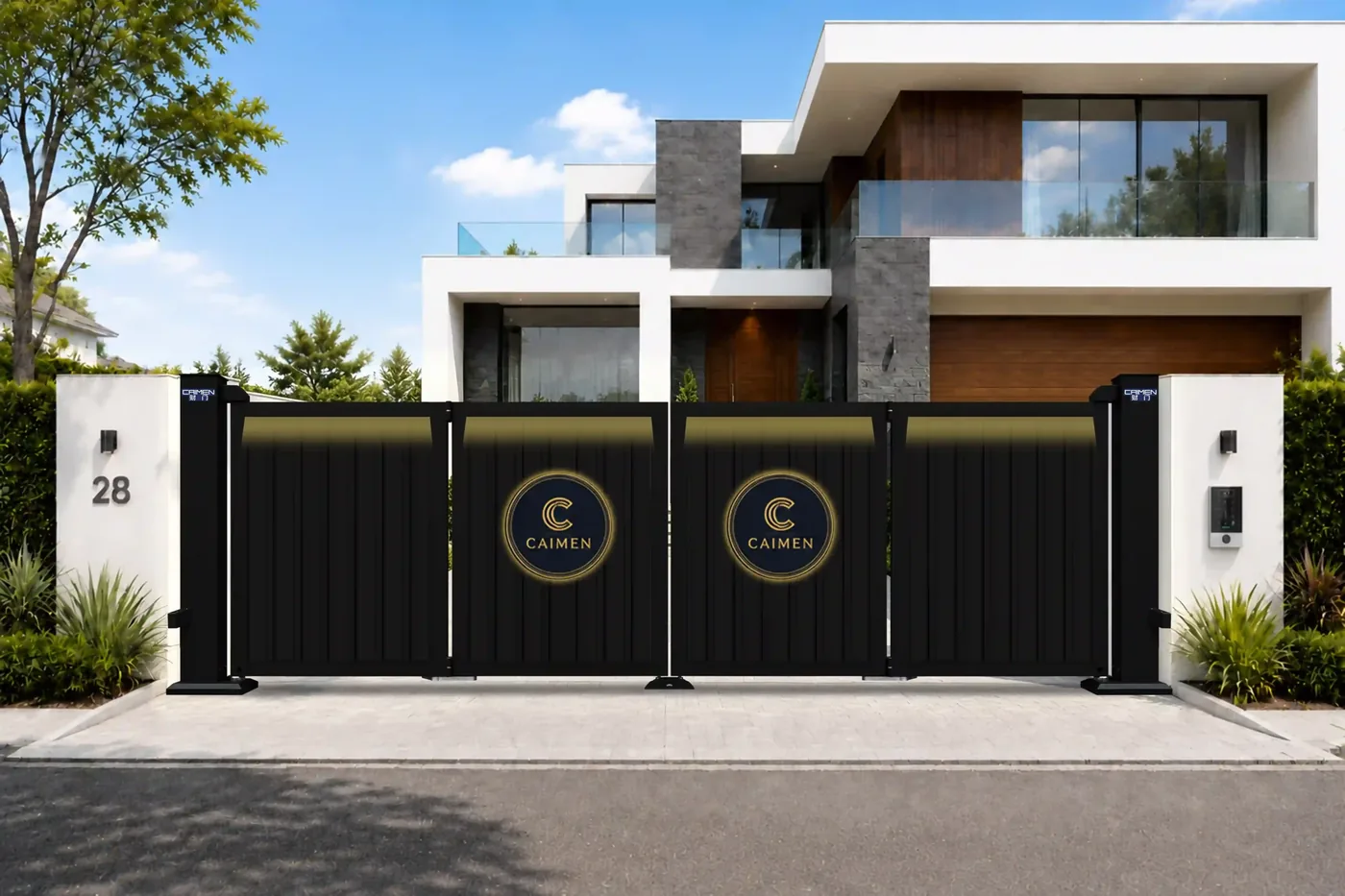
Stainless isn't compulsory. Plenty of seaside villas do well with an aluminum folding gate under a high-grade powder coat. Lighter leaves go easier on the hinges. You can also match the color to your window frames.
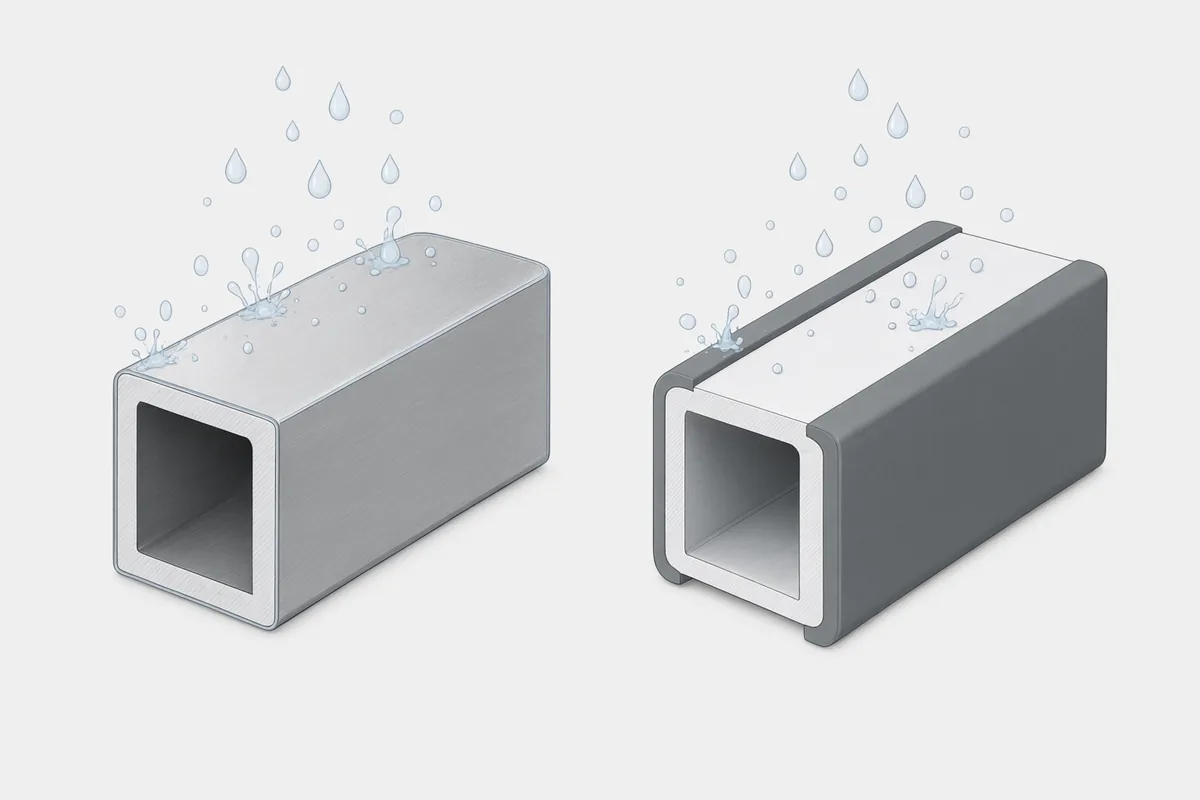
Our folding gate frames use 6005 and 6063 aluminum alloys. Standard finish is AkzoNobel Interpon D1000, a powder tested to AAMA 2603. Coastal clients usually step up to Interpon D2000, a superdurable powder tested to AAMA 2604, applied with CAIMEN's dual high-temperature curing process.
What does AAMA 2604 actually test? Tnemec's overview of the AAMA performance standards puts 2603 at the entry tier, where a one-year South Florida exposure is optional. 2604 is the architectural tier. There, extended South Florida weathering is mandatory, aimed at five years of color and chalk resistance. AkzoNobel's D2000 report matches: panels set at 45° facing south in South Florida for 5 years per ASTM G7, tested by ATLAS or Q-Lab, against limits of no more than 5 ΔE color change, a chalking rating of No. 8, and at least 30% gloss retention.
One warning. People muddle this constantly.
Those results belong to the AkzoNobel powder coating, not to a complete gate. A pass on AAMA 2604 says the paint film can take sun and weather. The hinge pins underneath? The motor housing? It says nothing about them.
Side-by-side: which build fits your site
| Factor | SS316 stainless + laminated glass | Aluminum + Interpon D2000 (AAMA 2604-tested powder) | Aluminum + Interpon D1000 (standard, AAMA 2603-tested powder) |
|---|---|---|---|
| Best for | Marinas, beachfront, direct spray | Seaside villas a short way back from the water | Inland or sheltered sites |
| Corrosion protection comes from | The metal itself (molybdenum-bearing alloy) | The coating film over aluminum | The coating film over aluminum |
| Coating test basis | Not coating-dependent | 5-year South Florida exposure on the powder | 1-year South Florida exposure on the powder |
| What to watch | Mixing in any non-316 fasteners | Chips and cut edges left unsealed | Better suited to sheltered sites than front-line spray |
| Look | Bright metal, glass infill | Any color, matte or gloss | Standard CM-01 gray or custom |
Say you're building three streets back from the beach, gate facing inland. D2000-coated aluminum will likely serve you well, in whatever color you like. Now picture a gate on the quay itself, drenched whenever the wind swings onshore. SS316. No debate.
Details that decide whether a coastal gate lasts
Grade gets the attention. These smaller calls carry just as much weight:
- No ground track. CAIMEN folding gates hang fully suspended on a patented top-bottom axis. Without an embedded track, there's nothing for sand, salt crust and standing water to fill. By the sea, a track is just a trough.
- Protected wiring. Cable run through sealed conduit, rather than draped loose across a hinge, leaves the terminals far less likely to corrode.
- Electrical safety. Our standard folding gate system includes 10 mA leakage detection with automatic power cut-off in under 0.1 s. Wherever water and electricity share a column, you'll be glad it's there.
- Low-voltage drive. It's a 24 V DC motor, so mains voltage never reaches the gate leaf.
- Rinse schedule. Even 316 likes a regular fresh-water rinse, more often after onshore winds. Leave salt sitting on it and it can still tea-stain.
Don't skip the rinse. You need a hose and ten minutes.
How to specify your coastal folding gate
Start with distance and exposure. Budget can wait. Tell us how far the gate sits from the waterline, which way it faces, and whether it takes direct spray. Then you'll choose the structure (SS316 or coated aluminum), the infill (glass, slats or solid panels) and the access control.
Drawn to glass and stainless? Our stainless steel glass folding gate page goes deeper into that build. For an all-aluminum folding gate across a residential drive, start with the bifold driveway gates range.
You'll see it before anyone cuts metal. CAIMEN prepares CAD drawings and renderings first, and production starts only after you approve them, typically 15 to 20 days after drawing approval. Send site photos and dimensions through the contact page or to yifei@gmail.com. Our engineers will suggest a material spec matched to how close to the sea you actually are.
Sources
- To understand the differences between 304 Grade and 316 Grade stainless steel applications (Pfannenberg)
- AAMA Performance Standards Explained (Tnemec)
CAIMEN product figures come from our installation manuals and engineering documentation.