Bifold gate vs swing gate sounds like a question about looks. Then you go out to the driveway with a tape measure, and it isn't. Open a swing leaf and it takes a slice of ground as deep as the leaf is wide. Fold a bifold and its panels bunch up in a short stack next to the post, claiming a fraction of that. Nearly everything else follows from this. Slopes, the car you park just inside, a gusty afternoon, the adjustments your crew makes in year five: all of it.
We'll take clearance first. Speed comes next, upkeep after that. And yes, we'll tell you where a swing gate still wins.
The swing arc vs the fold stack
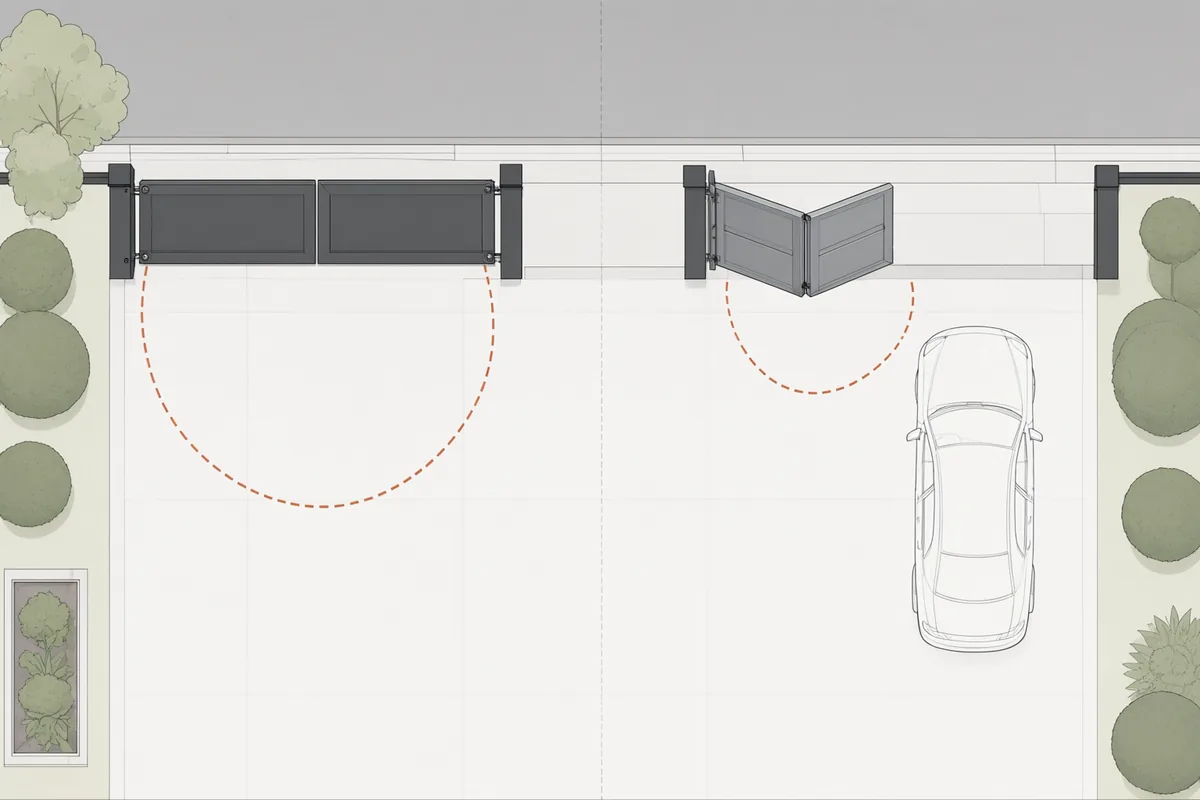
Geometry doesn't negotiate. Hinged on one edge, a swing leaf sweeps a quarter circle every time it moves. Put in a 12-foot single leaf and you need roughly 12 feet of clear depth behind the opening, plus a margin for the operator arm and the leaf's own thickness. Split it into a bi-parting pair? Each 6-foot leaf still wants about 6 feet. Nothing gets to live in that swing gate clearance zone. Not planters, not a parked car, not the trash cans or the bike your kid dropped on the way in.
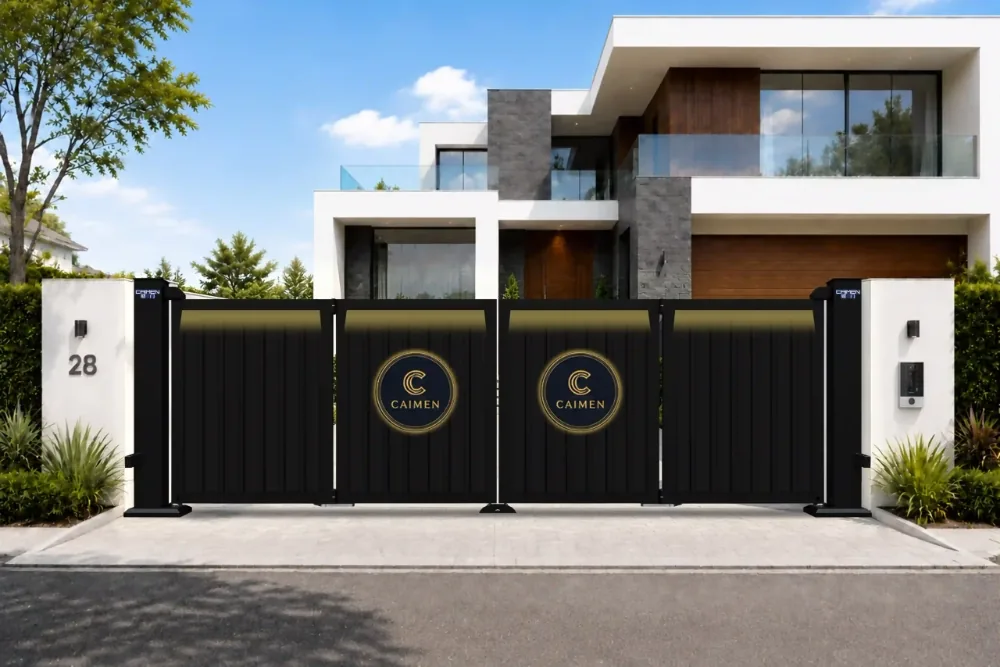
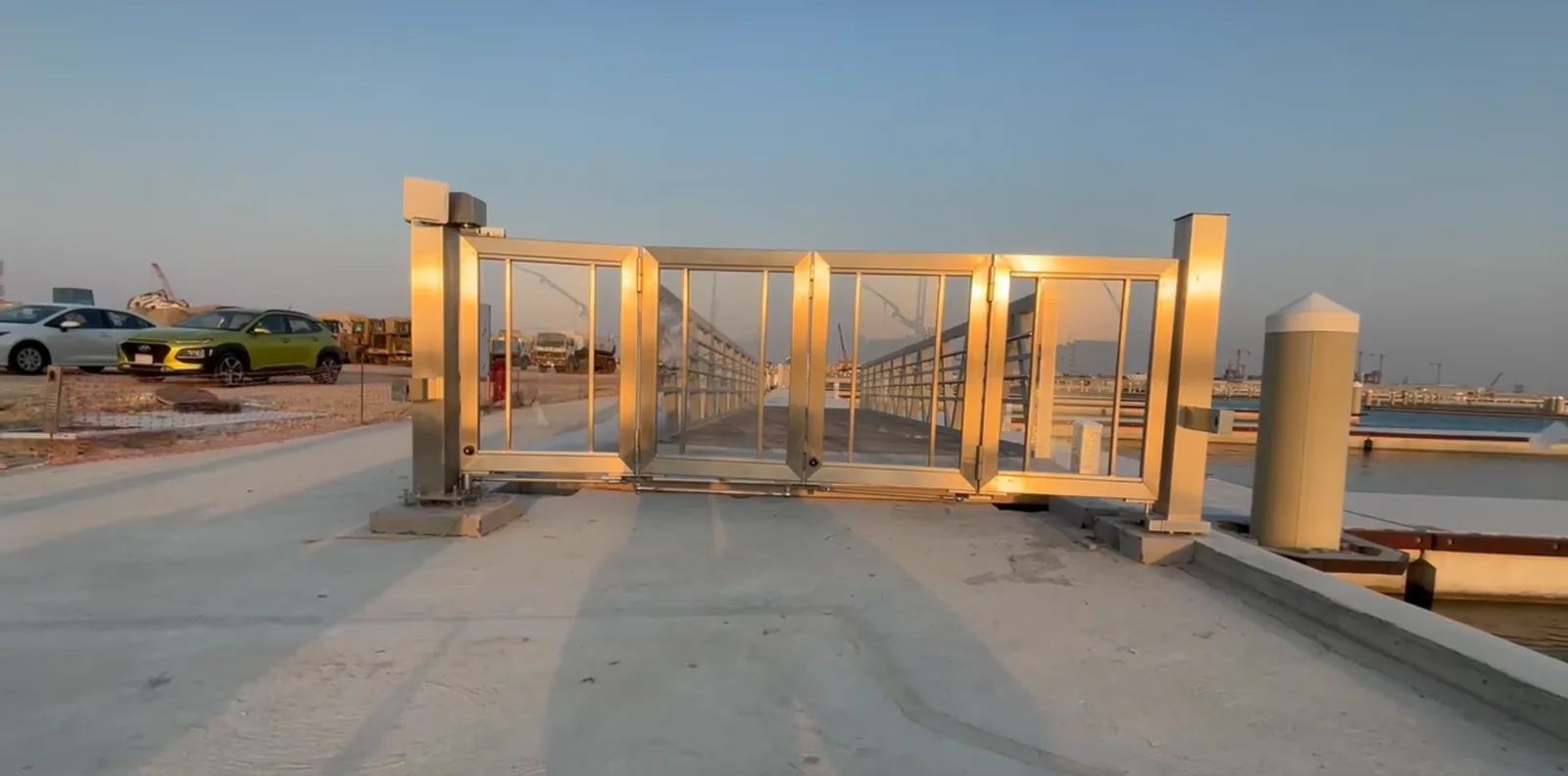
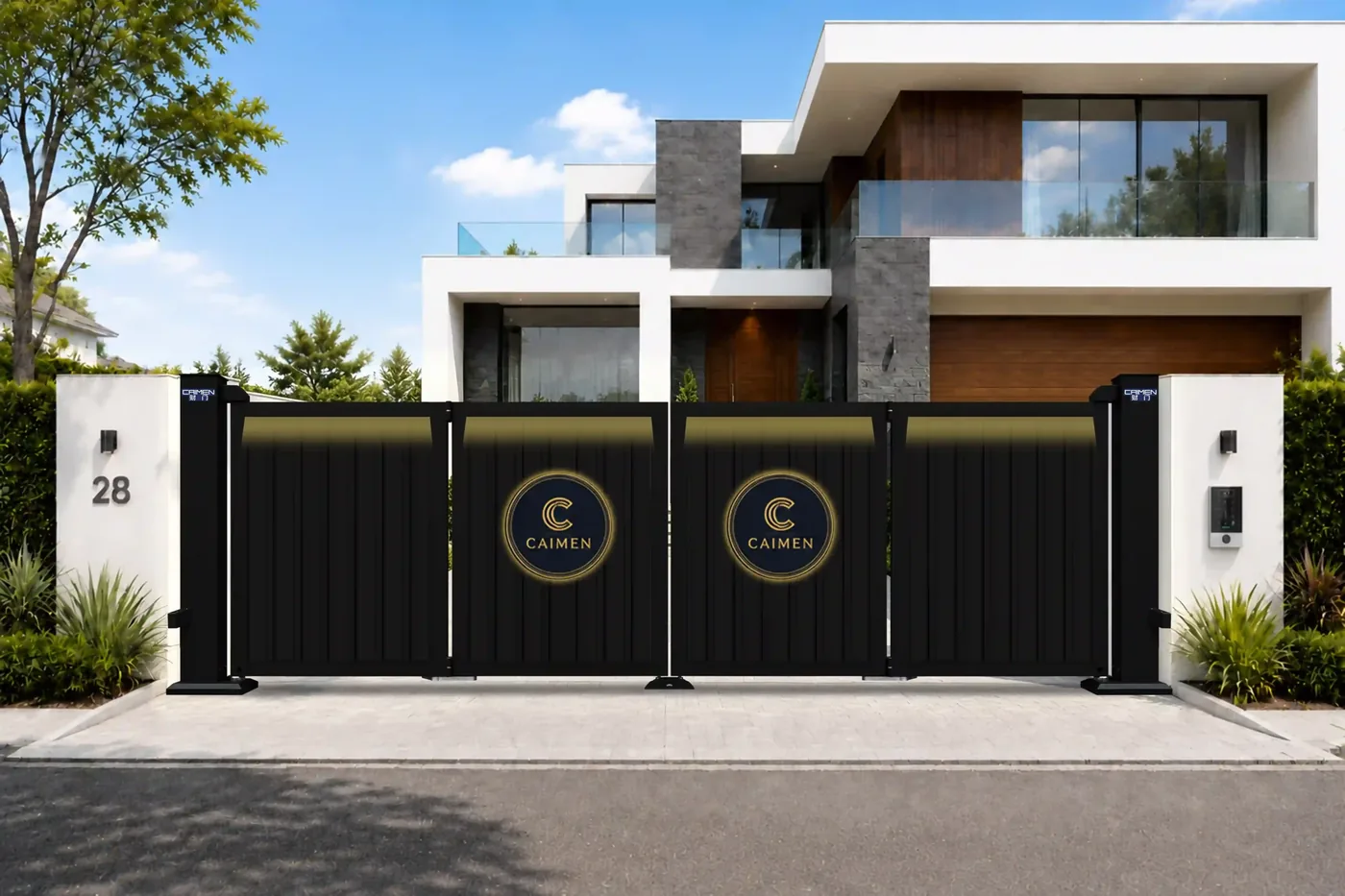
A bi folding gate plays by other rules. Each side is a set of hinged panels that fold against one another as they open, so the gate gathers near the post rather than swinging its full width into the drive. Our engineering documentation puts the goal plainly: compared with swing gates it cuts the arc-shaped opening space, and compared with sliding gates it drops the long side-travel run. There's still a sweep while the panels fold. It's just shallow.
Say your drive runs 20 feet from gate line to garage door. Two 8-foot swing leaves eat 8 of those feet on every opening. Put a bifold on the same opening and most of that apron stays yours.
Slopes and cars parked close
Here's where swing gates get awkward. Ground that rises behind the gate meets the bottom edge of the leaf partway through its arc. Every usual fix costs you something. You can swing the gate outward, often toward the street. You can raise the leaf and accept a bigger gap underneath. Or you fit rising hinges. Writing in Door and Access Systems (Fall 2022), John Allen notes that hillside properties with sloped roadways can be tricky and that grading only flattens so far. That's why dual-axis rising swing operators exist.
Folding won't erase a slope. What it does is shrink the strip of ground the panels cross, and often that's enough. So check the grade across the fold zone, not the whole depth of the drive. Near flat there? You're fine. Since we don't publish one fold depth for every size, confirm it against the CAD drawings for your opening, and our guide on how to measure a driveway for a bifold gate shows what to record.
Then there's the car. Imagine a townhouse where the second car sits a few feet inside the gate. With a swing gate, that car moves or gets hit, and if a forgetful teenager parked it, you'll learn which. A folding gate lets a car sit far closer, which is the whole point of our page on folding gates for small driveways.
Safety guidance cares about this as well. The gate safety guide from the Door and Access Systems Manufacturers Association (DASMA) treats the swing area, on both the public and secure sides, as an entrapment zone, and calls for photo eyes or edge sensors when the gap under a gate falls in a certain range. Less sweep means less zone to keep clear and protect.
Wind on large leaves
Think of a solid swing leaf as a sail on a hinge. Wind presses on its whole face, and since that load sits at the end of a long lever, the hinges, post and operator arm take the punishment. Long solid leaves on exposed sites are the textbook case. They stall, reverse or slam into the stop. Bigger operator, deeper posts: both help. You're still fighting the lever.
Folding shortens it. Narrower panels mean no single one reaches as far from its support, and once open, the stack sits tight by the post instead of standing across the drive like a billboard. That's a geometric advantage, not a wind rating, so don't read it as one. On a site with serious gusts, get the design checked against local wind conditions, whichever gate you buy. If privacy allows, choose open infill over solid panels. Honestly, that matters more than the finish color.
Opening speed: what 6 to 12 seconds means
CAIMEN's 24 V DC brushless folding gate system lists an operating time of 6 to 12 seconds. Swing gate times? They vary a lot with leaf size and operator, so distrust any single figure you see quoted. Often the real limit on a swing gate isn't motor power at all. It's safety: a heavy leaf crossing a big arc must move slowly enough to stop and reverse when something gets in its way.
Why care? Picture a car idling at the curb, its tail still in the street. Ten seconds is nothing from the kitchen window. From the driver's seat, with traffic piling up behind you, it drags. A shorter sweep helps on two fronts: less distance to travel, and less ground that has to be clear before the gate moves at all.
The motor spec lists a service life of at least 5,000,000 cycles and a working range of -30 to +70 °C. Soft start and soft stop (soft drive) come standard.
Top-bottom axis vs side hinges
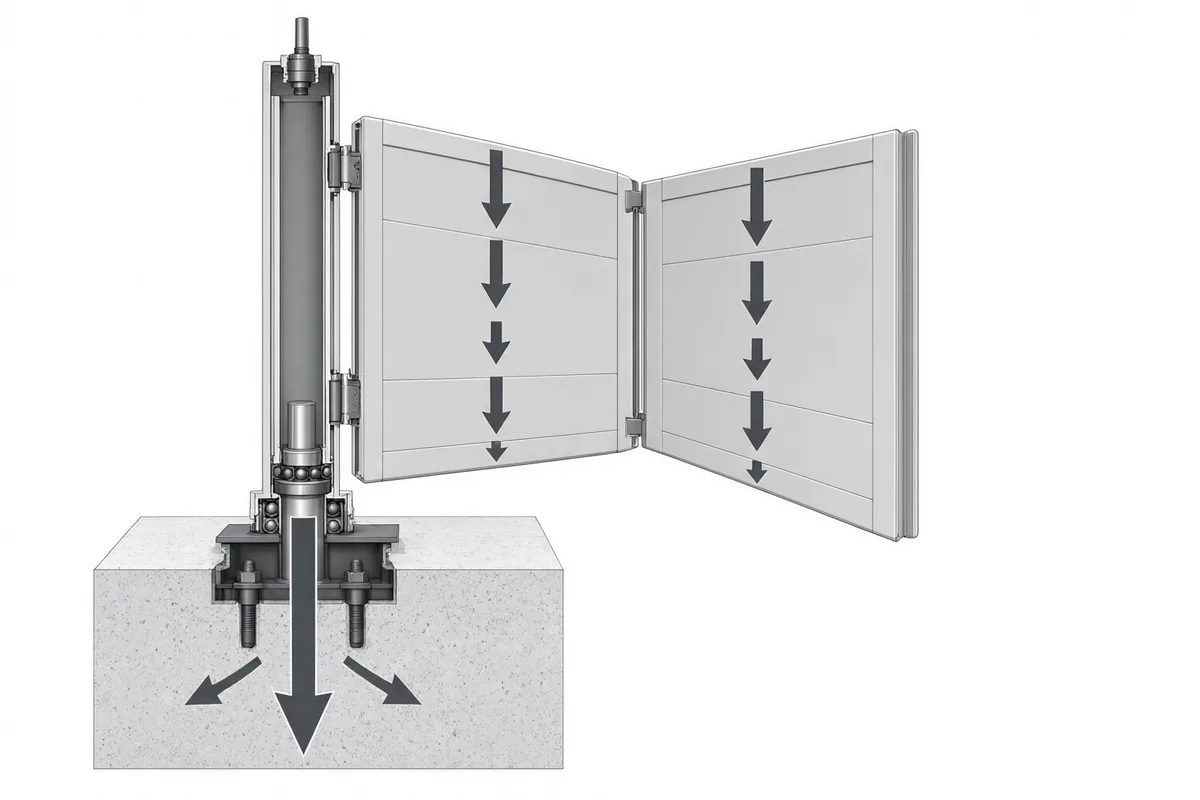
Most comparisons skip this. They shouldn't, because it decides how the gate ages. A swing leaf hangs off side hinges bolted to a post, its whole weight cantilevered from one edge. Give it time and the latch end sags while the post starts to lean. If you've ever re-shimmed a drooping wooden garden gate, you know the pattern. Big metal gates do the same, just slower and with a bigger repair bill.
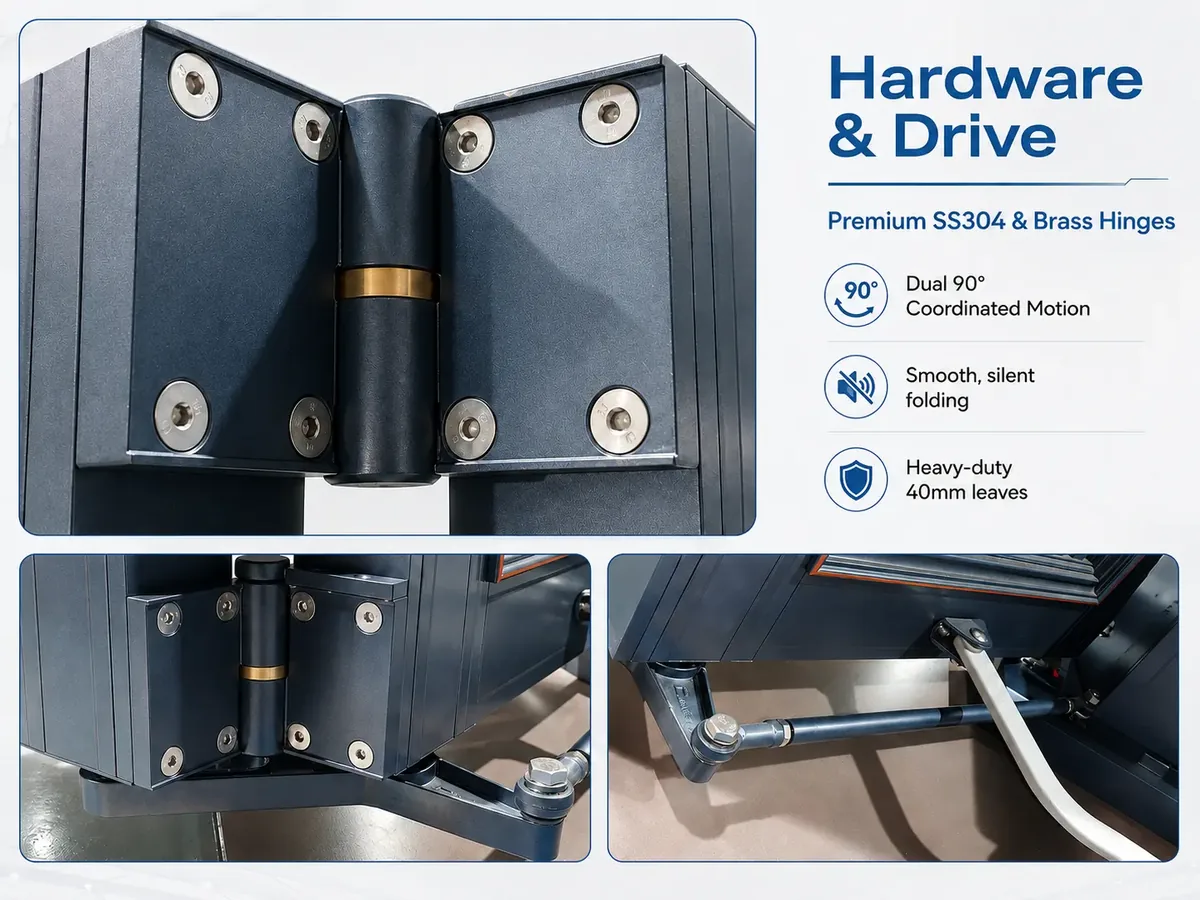
CAIMEN's bifold uses a patented top-bottom axis instead. The top guides; the bottom carries the load. Weight runs down through the bottom pivot into the foundation rather than hanging off side connection points. CAIMEN's engineering data puts the result at roughly 60% less mechanical wear than a conventional support shaft and up to 3 times the service life, with one bearing assembly supporting 5 to 10 tons. Panels turn on a 40 mm, 304 stainless steel hinge shaft cast at 1500 °C. And a dual-track synchronized 90° guide keeps both sides folding in step, so neither lags and binds.
No track is buried in the drive, either. Our installation manual describes full suspension operation without pre-embedded tracks, so rain, snow and standing water can't jam it. For the full build, see the bi-folding gate page.
Side-by-side comparison
| Factor | Swing gate | CAIMEN bifold gate |
|---|---|---|
| Space behind the gate line | About one full leaf width of clear depth | Short fold sweep; panels stack beside the post |
| Sloped driveway | Leaf can strike rising grade; rising hinges or outward swing needed | Only the fold zone needs checking |
| Cars parked close | Swing zone must stay empty | Car can sit much closer to the gate line |
| Wind on large leaves | Long lever arm loads hinges, post and operator | Narrower panels; compact stack when open |
| Opening time | Varies with leaf size and operator | 6 to 12 s (24 V DC brushless system) |
| Load path | Weight hangs off side hinges | Top guidance, bottom pivot carries the load |
| Ground track | None | None; full suspension, no pre-embedded track |
| Typical upkeep | Hinge grease, sag adjustment, arm brackets | Pivot and fold guide checks, sensor tests |
Upkeep over the years
Swing gates are simple. Simple is easy to service. You grease the hinges, watch for sag, snug up the operator brackets, keep the swing zone clear and the sensors lined up. Sag is the one that bites. Once a leaf drops, the latch stops lining up and the operator strains on every cycle from then on.
More joints on a bifold, so more work? Some, yes. Plan to look over the pivots, the fold guide and the cable path. The design takes part of that off your plate: cabling runs through a 304 stainless steel flexible conduit, and the system adds 10 mA leakage detection with automatic cut-off in under 0.1 s, infrared anti-collision, a manual clutch, mechanical self-locking and motor thermal protection. On the 24 V control system you get a 7-day replacement and 1-year warranty for quality issues.
Whichever you pick, DASMA's advice stands. Test the sensors and reverse function regularly. Post warning signs. Give people on foot their own path.
When a swing gate is still the right call
Look hard at your site. Deep flat forecourt, modest opening, nobody parking near the gate line? A swing gate is a perfectly good choice there. Every installer knows it, and it suits a traditional facade.
Go bifold when depth behind the gate is short, the drive slopes, cars park close, or the opening's wide enough that a swing leaf becomes a sail. Still weighing it? Send your opening width, the depth you have behind the gate line and a note on the slope to yifei@gmail.com or through the contact page. CAIMEN draws up CAD drawings and renderings before anything gets built, and production typically takes 15 to 20 days after drawing approval.
Sources
- Gate System Safety (Door and Access Systems Manufacturers Association, DASMA)
- Designing access points with obstacles in mind, Door and Access Systems, Fall 2022
CAIMEN product figures come from our installation manuals and engineering documentation.