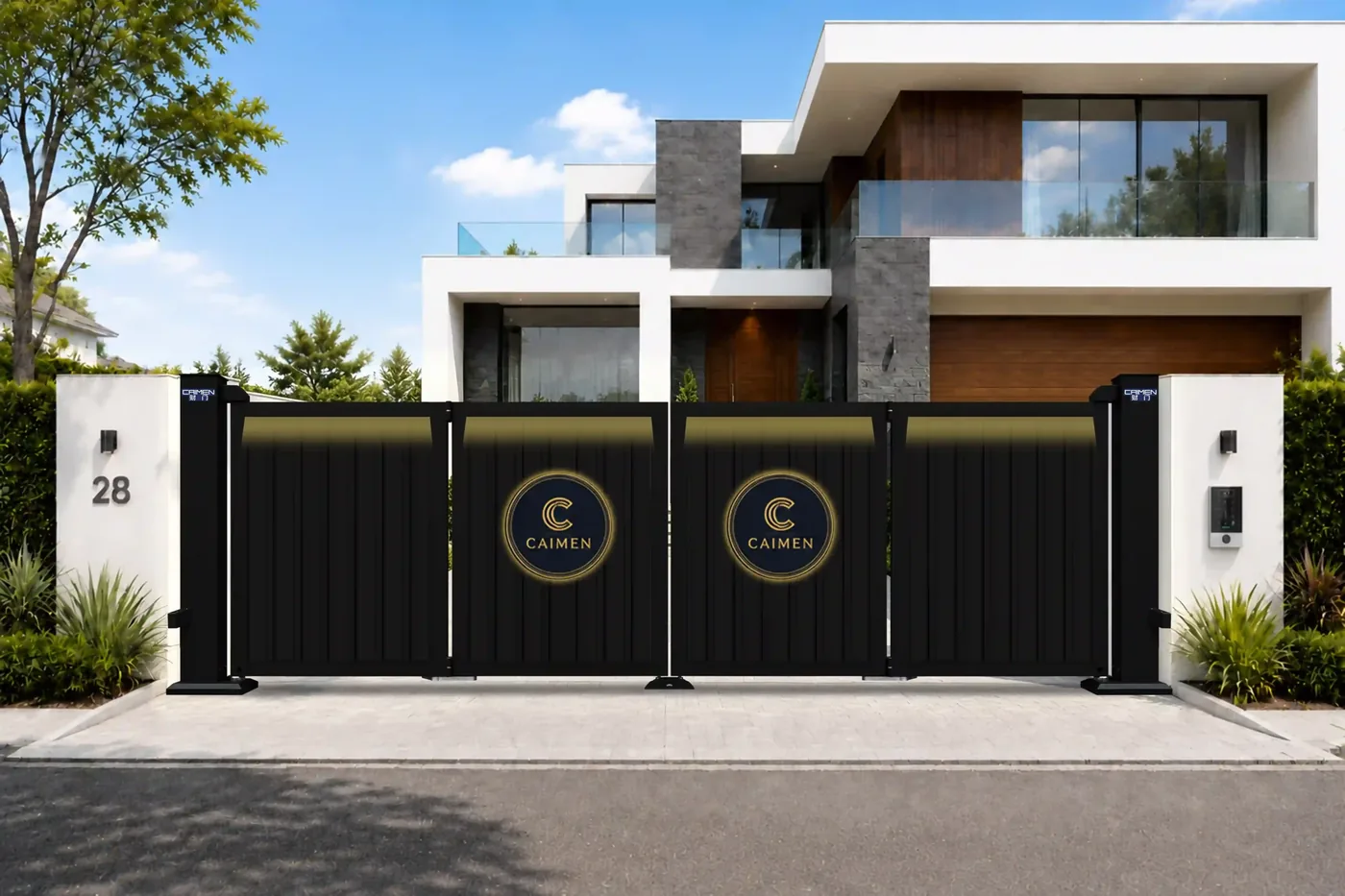
Most people shopping for a bifold gate pick the panels first. Slats or solid, black or bronze. I get it. Yet after a month of driving through it, you won't think about the slats much at all. You'll think about the motor: how quickly the leaves get out of your way, whether the gate rattles open when a storm rolls through, and what you do at 11 p.m. when the street's lost power. So here's what to check on an automatic bifold gate motor, with CAIMEN's 24 V brushless drive as the worked example so every number has something real behind it.
Why 24 V DC took over residential gates
Walk past a few newer gated homes. Odds are a good share of the openers run on 24 V DC, not mains AC. That isn't fashion. A low-voltage opener guide from Apollo Gate Openers on low-voltage gate openers says voltage drop is less significant at 24 V than at 12 V, and describes low-voltage units as cooler running and more compact. There's a family angle too. Kids, dogs and garden hoses all drift toward the hinge column sooner or later, and low voltage on the moving leaf is simply calmer.
DC is also easy to control. Soft start, soft stop, instant reverse when something's in the way: a decent DC controller does all three without fuss.
Then there's brushless. GlobalSpec's overview of brushless motors explains that with no brushes, nothing rubs itself away, routine maintenance drops, and cooling gets easier since the electromagnets sit on the stator. If your gate cycles ten or twenty times a day, you'd rather own a motor you can forget about than one that needs periodic brush service.
The core numbers, and what they actually mean
Spec sheets bury the useful lines among the filler. Below is how CAIMEN's 24 V bifold gate opener reads, per our engineering documentation, with the question I'd put to any supplier next to each row.
| Spec | CAIMEN 24 V system | What to ask about it |
|---|---|---|
| Motor type | 24 V DC brushless | Brushless, or a brushed DC motor sold under a vague label? |
| Power | Rated 200 W (output 120 to 200 W) | Matched to your leaf weight and width |
| Current | 6 A | Check the wiring and protection suit it |
| Power supply | 24 V / 10 A | You want headroom above the motor draw |
| Motor speed | 1,400 rpm, 4-pole, insulation class F | Class F tells you how hot the windings may safely run |
| Gear ratio | 300 | This sets the torque at the hinge |
| Opening time | 6 to 12 s | Adjustable on site? It should be |
| Service life | 5,000,000 cycles or more | Make sure the figure is for the motor, not something vaguer |
| Working conditions | -30 to +70 °C, humidity up to 85%, altitude up to 1,000 m | Compare it with your own winters and summers |
Power and current
More watts won't save you. A folding leaf swings on pivots instead of dragging along a track, so it never needs the brute force of a heavy sliding gate. What matters is smooth movement in a crosswind without the motor straining on every cycle. At 200 W rated and 6 A, on a 24 V / 10 A supply, there's sensible margin left over.
Gear ratio and opening time
Torque comes from the 300 ratio. It takes 1,400 rpm at the motor and turns it into a slow, strong twist at the pivot, which is what a folding panel wants. Opening runs 6 to 12 seconds. Picture yourself turning in off a busy road with a pickup on your bumper. Twelve seconds feels endless then; six feels fine. CAIMEN's controller stores opening and closing speed as parameters L01 and L02 (default 50, range 20 to 95), so your installer tunes it to the site instead of leaving a factory guess in place.
Cycle life and temperature
At 5,000,000 cycles or more, the motor is rarely what fails first at a home. Seals, cabling and the quality of the install usually set the real lifespan. The -30 to +70 °C range covers most of a Minnesota winter and a Phoenix summer, though if your site sees extreme cold, check it against that -30 °C floor. Humidity is rated to 85%. Right on the coast? Keep that in mind.
Safety features you shouldn't skip
Honestly, this section matters more than the finish color. Folding gates have hinges and closing gaps. A motor that can't stop itself is a liability. CAIMEN's system ships with all of these as standard:
- Mechanical self-locking. The drive self-locks mechanically when it's stopped, holding the leaves in place.
- Emergency manual clutch. Power's out? Release the clutch and fold the leaves by hand.
- Thermal protection. Say it's a hot afternoon and the gate's been cycling nonstop; the motor guards itself against overheating.
- Leakage detection. Once leakage current hits 10 mA, power is cut automatically in under 0.1 s.
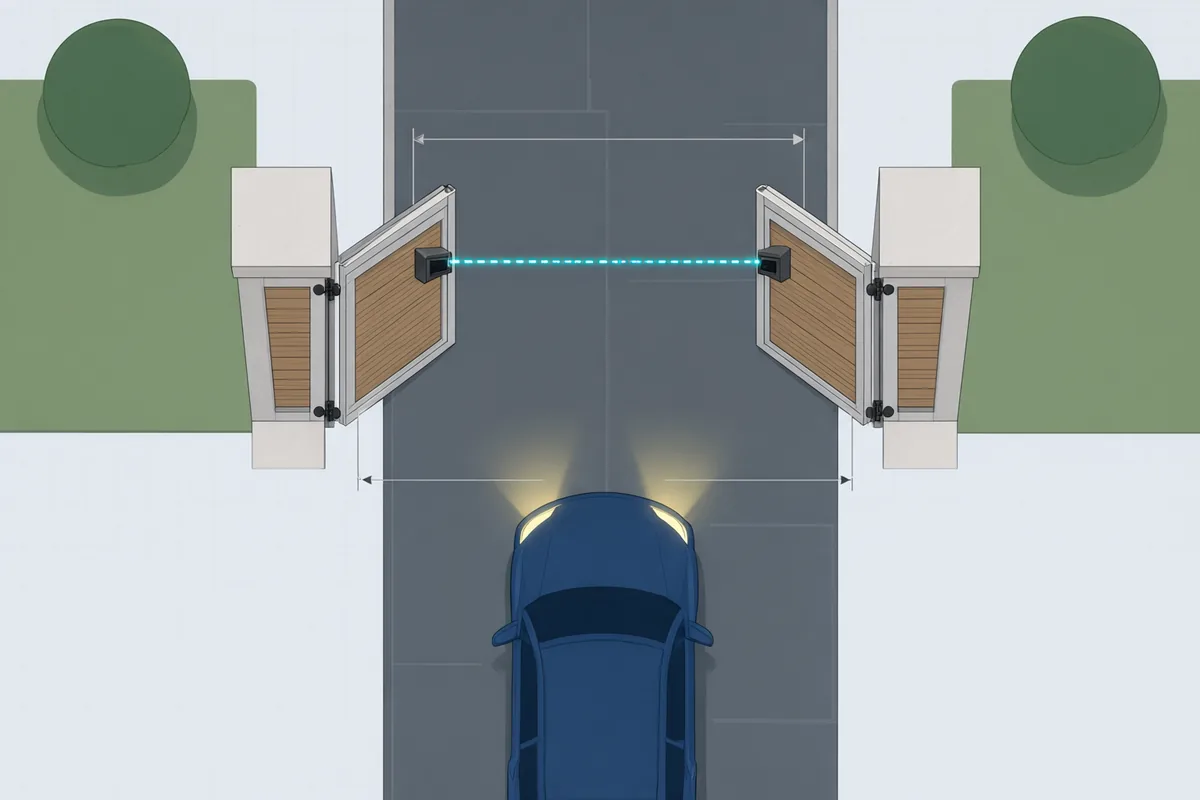
- Infrared anti-collision. Break the beam and the gate stops, then reverses.
- Soft drive and emergency stop. Gentle starts spare the hinges. The stop button ends motion instantly.
You also get a warning light, with voice announcements as an option. One caveat, and it's a real one: entrapment rules differ from town to town, so ask your installer what your local code or HOA expects before the layout is final.
Pairing two leaves: master and slave
A double bifold has two drives. They have to move together. Let one side lag a beat and you'll see uneven closing and extra wear on the leaves. CAIMEN's 24 V controller fixes this with one setting, L-21: 0 makes a controller the master, 255 makes it the slave.
Commissioning has a catch worth knowing as a buyer: obstacle bounce-back only goes live after the self-check (hold Close for 2 seconds; the display reads 190 at the closed limit) plus two complete open and close cycles. Fault codes help later, E-1 for over-current and E-2 for a motor wiring fault. Our installation page has the full sequence.
Where the motor lives, and how it's wired
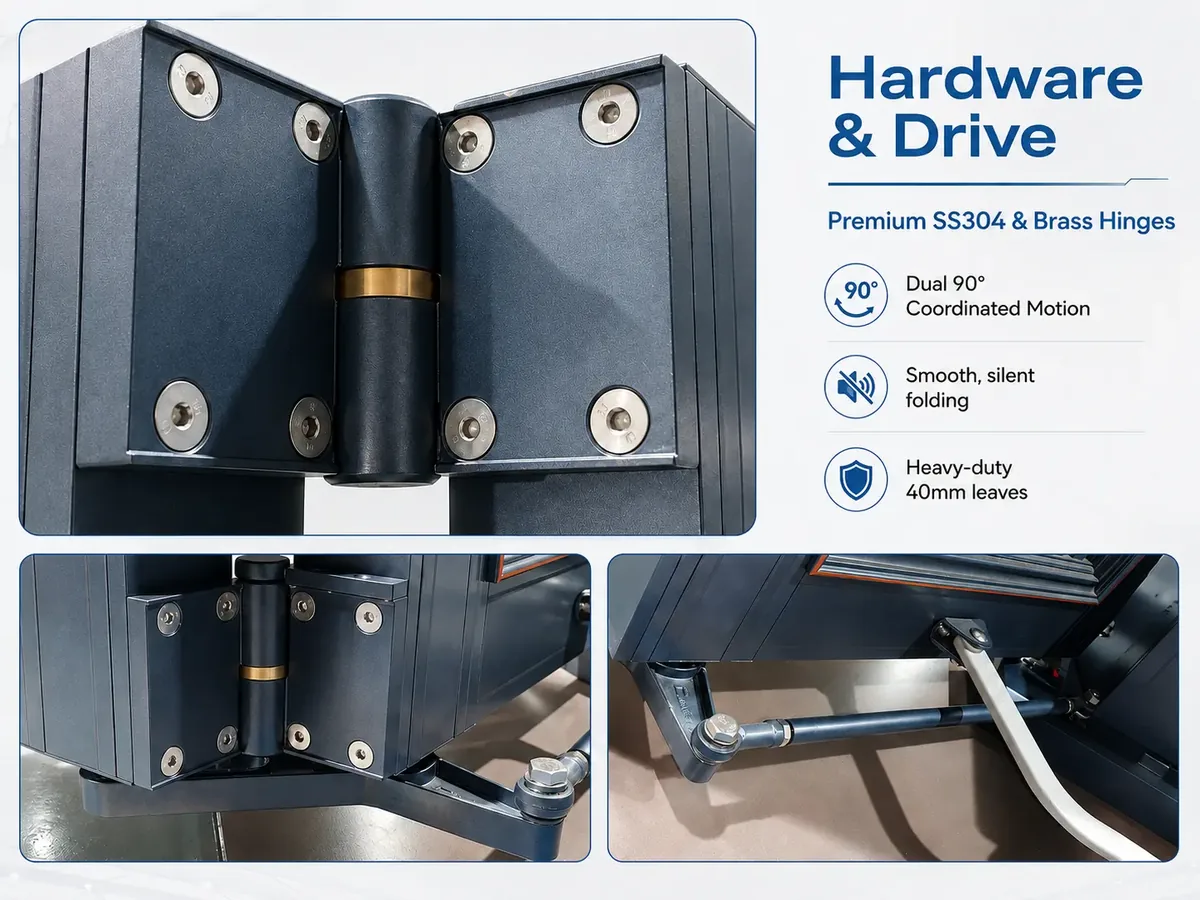
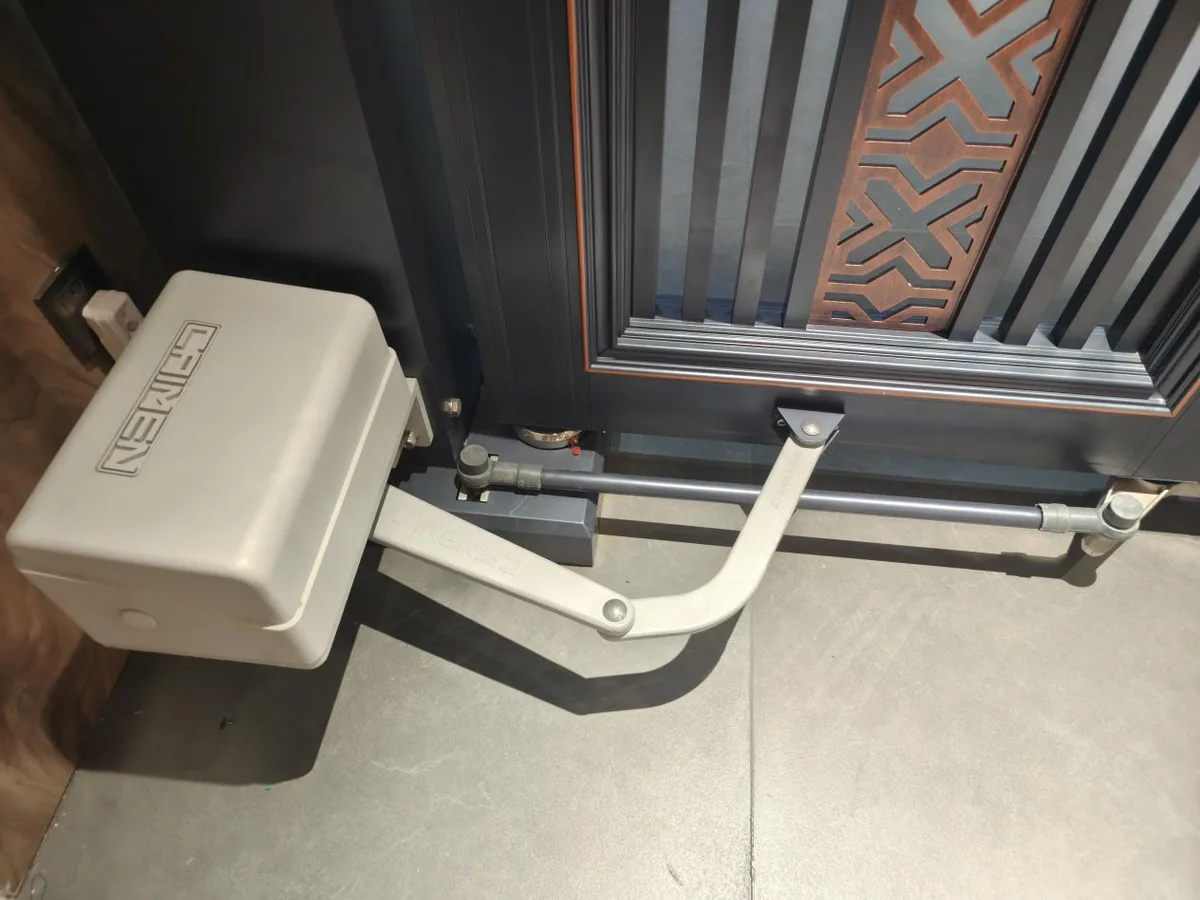
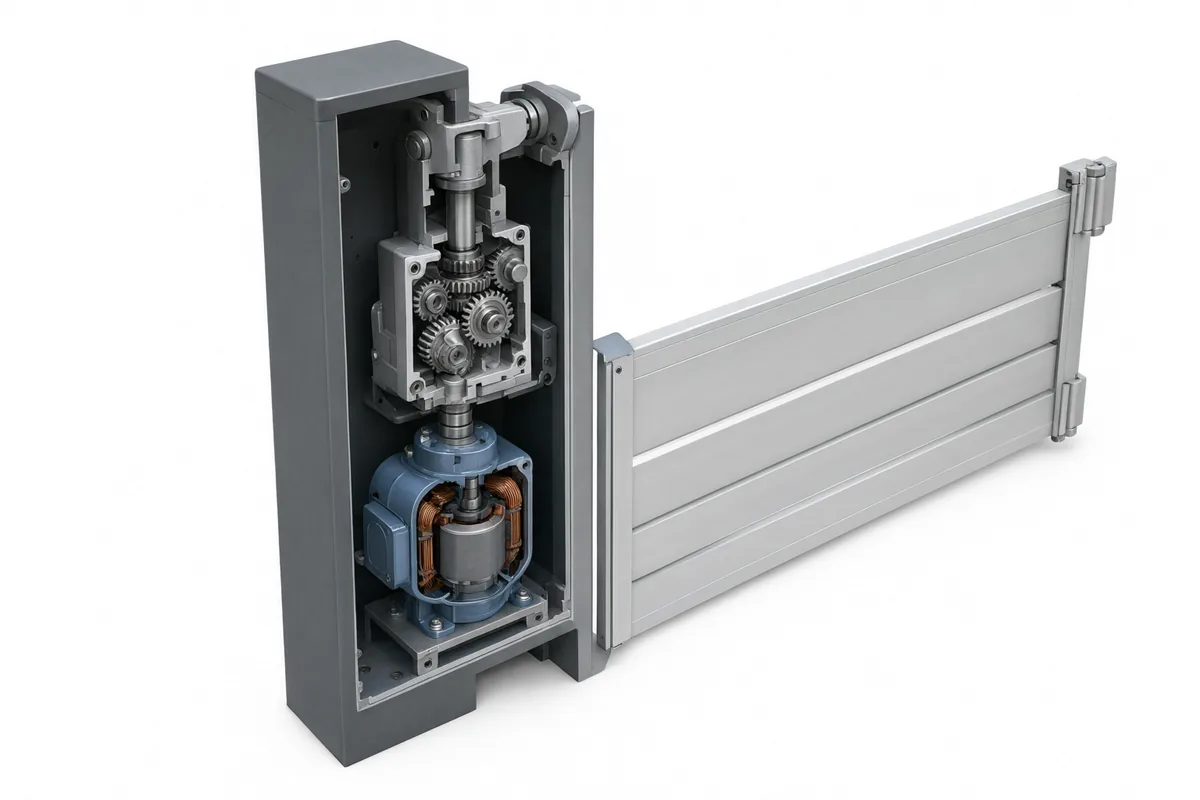
Plenty of folding gates get an operator bolted on as an afterthought. Not this one. CAIMEN puts the motor inside the column and pairs it with a patented top-bottom axis, where the top pivot guides and the bottom pivot carries the load down into the foundation. Nothing hangs off the post. No mirror snags, no pile of leaves behind a bracket.
Wiring gets ignored until it fails. Here, power reaches the moving leaf through a 304 stainless steel flexible conduit carrying a custom four-core cable in 99.99% oxygen-free copper. It's the one cable that bends every cycle, so it deserves the protection.
On top of that sits the 10th Gen control system. Use license plate recognition, a keypad, the mobile app, RFID, video intercom, Bluetooth, radar or ground loops, whichever suits your household. Browse the range on our automatic bifold gates page.
Warranty terms: read them closely
Gate motor warranties are often written to sound bigger than they are. So here's ours, plainly. The 24 V control system carries a 7-day replacement and a 1-year warranty for quality issues. Damage from an unsuitable power supply or temperature conditions isn't covered. Neither is improper operation, or someone taking the unit apart.
That's narrower than a blanket promise. We'd rather you know. When you line suppliers up, ask which component the warranty names, because a long number attached to "the gate" can mean very little if the controller sits outside it.
A short checklist before you buy
- Is the motor 24 V DC brushless, with rated power and current on paper?
- Does the opening time come as a range you can adjust?
- Are cycle life and a working temperature range stated, and does that range fit your climate?
- Self-locking, manual clutch, thermal protection, leakage cut-off: standard or extras?
- Can one controller pair two leaves as master and slave?
- Does the warranty name the control system and list what's excluded?
A supplier who answers all six without hedging is probably worth talking to. Got a specific opening in mind? Send your drive measurements to yifei@gmail.com or reach us through the contact page, and we'll come back with drawings.
Sources
CAIMEN product figures come from our installation manuals and engineering documentation.